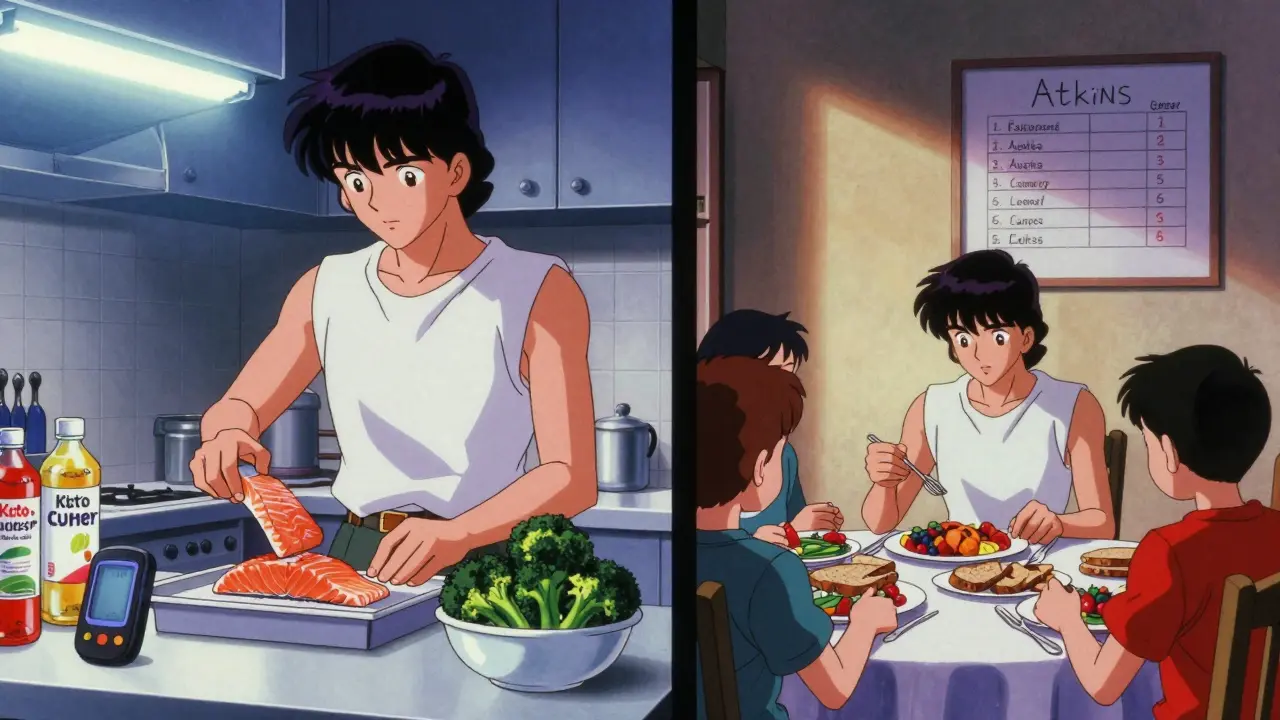
When it comes to losing weight, few dietary approaches have sparked as much debate as the ketogenic diet and the Atkins diet. Both promise fast results by slashing carbs, but they’re not the same. One locks you into a strict fat-burning state. The other lets you ease into it - and out of it. If you’re trying to drop pounds and don’t know which path to take, here’s the real breakdown: what works, what doesn’t, and who each diet actually suits.
How Keto Works - and Why It’s So Strict
The ketogenic diet, or keto, was originally developed in the 1920s to treat epilepsy. It wasn’t meant for weight loss - but people quickly noticed the side effect. Today, it’s built on one core rule: keep carbs so low that your body switches from burning sugar to burning fat for fuel. That’s called ketosis.
To get there, you need to eat about 75-90% of your calories from fat, 15-20% from protein, and only 5-10% from carbs. That usually means under 50 grams of carbs per day. No, that’s not a typo. It’s less than one banana. You’re cutting out bread, pasta, fruit, even sweet potatoes. Your main foods? Meat, eggs, cheese, butter, nuts, and leafy greens.
Here’s the catch: protein has to be controlled too. Too much protein? Your body turns it into glucose through a process called gluconeogenesis. That can kick you out of ketosis. So even chicken breasts and Greek yogurt need measuring. And forget processed ‘low-carb’ snacks - real keto avoids them. It’s whole foods only.
Most people feel awful for the first two to four weeks. Headaches, fatigue, brain fog - it’s called the ‘keto flu.’ About 70-80% of new dieters go through it. Your body is literally rewiring how it gets energy. But once it adapts? Many report steady energy, fewer cravings, and rapid weight loss - often 10-20 pounds in the first month.
How Atkins Works - and Why It Feels More Flexible
The Atkins diet, created by Dr. Robert Atkins in 1972, takes a different route. Instead of staying locked in one mode, it has four phases. It’s like a diet with a built-in exit ramp.
Phase 1 (Induction): You eat just 20-25 grams of net carbs per day - almost keto-level. You focus on protein, fats, and non-starchy veggies. This lasts at least two weeks.
Phase 2 (Ongoing Weight Loss): You slowly add back carbs - 5 grams at a time - until weight loss resumes. Now you’re eating 25-50 grams daily. You can add nuts, berries, and small amounts of legumes.
Phase 3 (Pre-Maintenance): You’re up to 50-80 grams of carbs. You can enjoy whole grains, fruits, and starchy veggies again. This is where most people plateau, and many realize they don’t need to go back to eating like they did before.
Phase 4 (Lifetime Maintenance): You’ve found your personal carb tolerance. For many, that’s 80-100 grams daily. You can eat rice, potatoes, and even occasional sweets - as long as you don’t regain weight.
Unlike keto, Atkins doesn’t restrict protein. You can eat more chicken, fish, and lean meats without worrying about breaking a metabolic state. And yes, Atkins has its own line of snacks - protein bars, shakes, and frozen meals. They’re convenient, but not exactly ‘clean eating.’
Which One Burns More Fat - Short Term?
In the first 3-6 months, both diets deliver serious results. A 2014 study showed people on a low-calorie keto diet lost an average of 44 pounds. Those on a standard low-calorie diet lost only 15. That’s a huge difference.
Atkins isn’t far behind. A 2013 study with obese adults with type 2 diabetes found that after 24 weeks, they lost weight, lowered their blood sugar, and needed fewer diabetes meds. The numbers were similar to keto - but without the extreme restrictions.
So why does keto seem faster? Because it forces your body into fat-burning mode right away. Your liver starts making ketones, which suppress appetite. You’re not hungry. You’re not craving sugar. You’re just burning fat.
Atkins works too - but more gradually. You’re not in ketosis the whole time. You’re just eating fewer carbs than you used to. That’s still effective. But the initial drop might be slower.
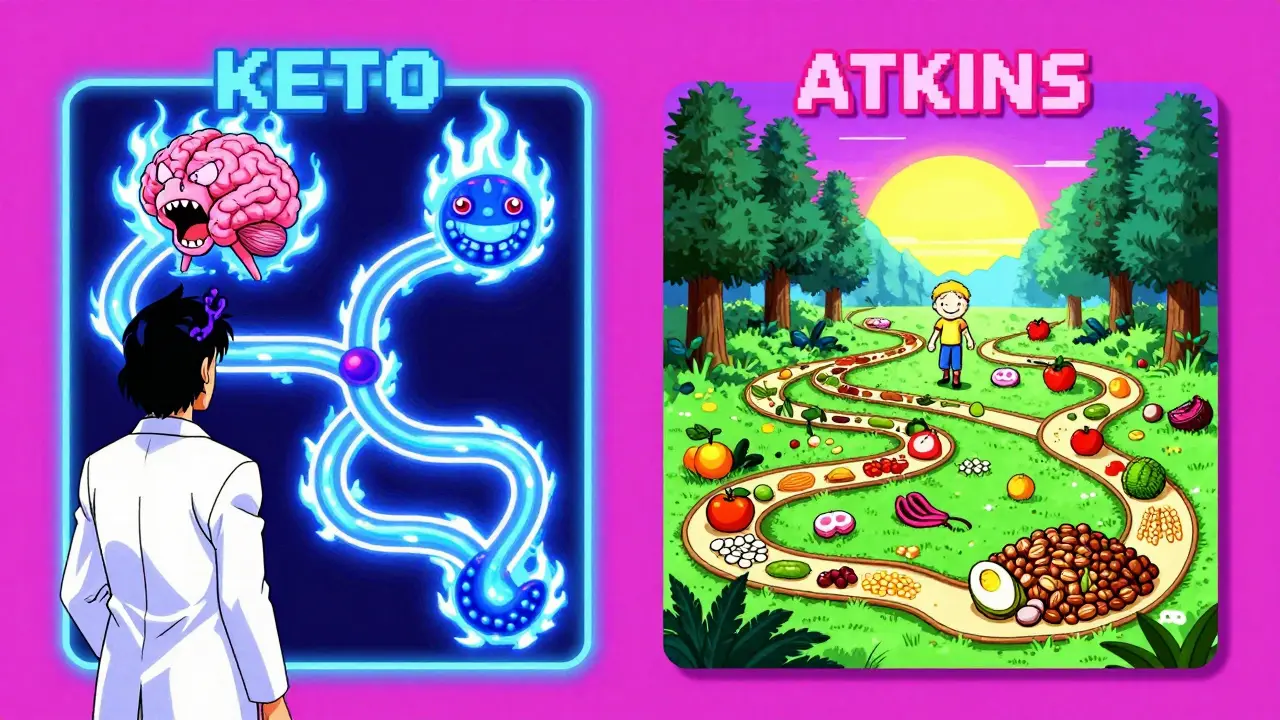
What Happens After 6 Months?
This is where things get interesting - and a little disappointing.
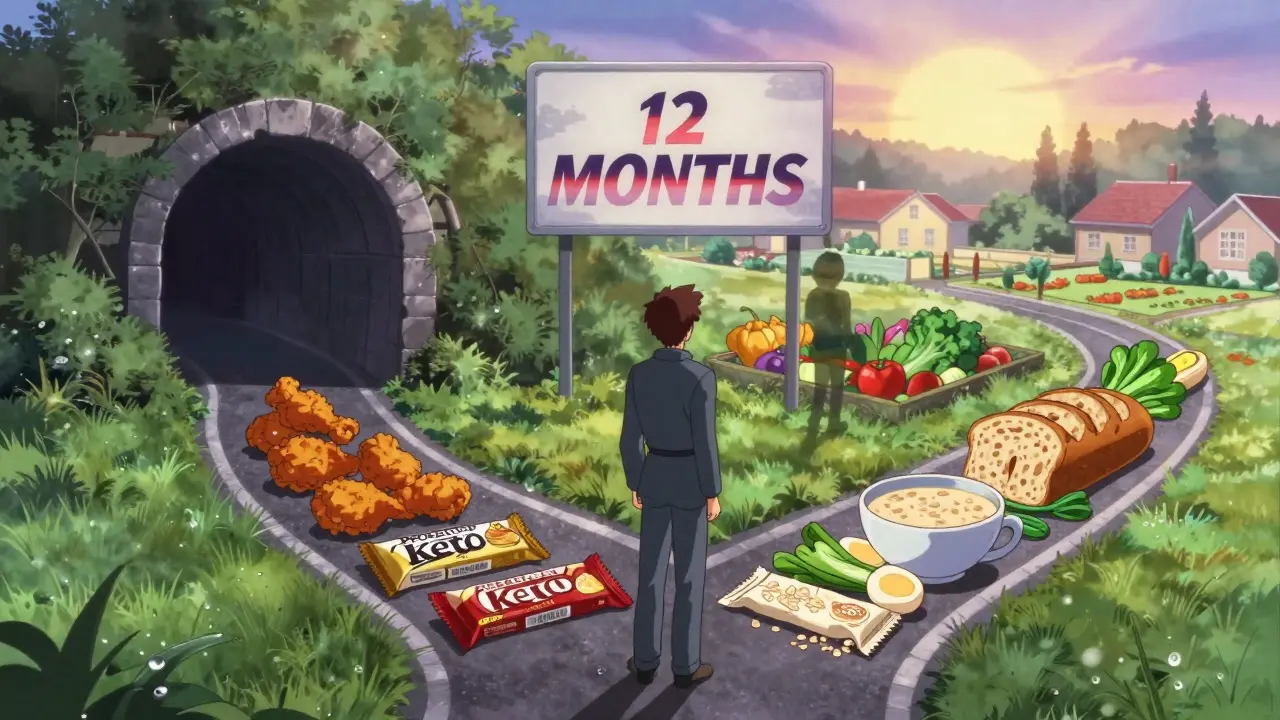
Long-term studies, including one from Harvard, show that after 12 months, people on keto, Atkins, and even standard low-fat diets all lose about the same amount of weight. The initial advantage fades. Why? Because diets are hard to stick to.
Keto’s problem? It’s too rigid. One slice of pizza, one glass of wine, and you’re out of ketosis. Many people quit because they can’t live without bread, fruit, or even a small piece of dark chocolate. A 2023 survey found only 35% of keto dieters were still following it after a year.
Atkins wins here. Phase 4 isn’t a ‘cheat’ - it’s a lifestyle. You learn how much carb you can handle without gaining weight. That’s real. That’s sustainable. And 48% of Atkins dieters were still on it after 12 months.
What About Your Health - Not Just Your Weight?
Weight loss is great. But what about your heart, liver, and long-term health?
Keto often means eating more saturated fat - butter, bacon, cheese, coconut oil. That’s fine if you’re eating whole foods. But if you’re eating processed keto bars and fried chicken every day? You’re increasing LDL cholesterol. Dr. Neal Barnard from the Physicians Committee for Responsible Medicine warns this could raise heart disease risk.
Atkins doesn’t avoid saturated fat either. But because it allows more variety - fruits, legumes, whole grains - it’s easier to get fiber, antioxidants, and nutrients. That’s better for gut health and long-term inflammation.
Both diets improve blood sugar control. That’s why they’re recommended for prediabetes and type 2 diabetes. But the American Diabetes Association says long-term safety data is still limited. So if you’re diabetic, work with a doctor.
Who Should Choose Keto?
Keto is best for people who:
- Want fast, dramatic results in the first few months
- Don’t mind strict rules and measuring every meal
- Can handle the ‘keto flu’ without quitting
- Are comfortable with high-fat foods and low protein
- Use apps like Carb Manager or KetoDiet to track intake
If you’re someone who thrives on structure - and doesn’t care about occasional treats - keto might work. But if you love fruit, pasta, or wine? You’ll likely quit.
Who Should Choose Atkins?
Atkins is better for people who:
- Want to lose weight but still enjoy carbs occasionally
- Prefer a step-by-step plan with clear progress
- Don’t want to count fat or protein - just carbs
- Like convenience foods (Atkins bars, shakes, meals)
- Plan to keep the diet going for years, not just months
Atkins 40 (starting at 40g carbs) is especially popular with people over 35. It’s less extreme. It’s more realistic. And Phase 4? It’s not a failure - it’s the goal.
The Bottom Line
Neither diet is magic. Neither is a cure. Both work because they cut out sugar, refined carbs, and processed foods. That’s the real win - not ketosis or phases.
If you want fast results and can handle the grind - go keto. But be ready for a steep climb.
If you want to lose weight and still eat a bowl of oatmeal or a slice of whole-grain bread someday - go Atkins. Let it guide you to a lifestyle, not a prison.
Most people who stick with either diet lose weight. But only those who find a way to live with it long-term keep it off. That’s the real test - not the first 30 days.
Can I do keto and Atkins together?
You can start with keto’s induction phase and then transition into Atkins Phase 2 or 3. Many people do this - they use keto to jumpstart weight loss, then switch to Atkins for long-term flexibility. But don’t try to follow both at once. They have different rules for protein and fat. Stick to one plan at a time.
Is one diet safer than the other?
Both diets are generally safe for healthy adults. But keto’s high saturated fat intake can raise LDL cholesterol in some people. Atkins allows more plant-based foods, so it’s often better for heart health long-term. If you have high cholesterol, diabetes, or kidney issues, talk to your doctor before starting either.
Do I need to buy special foods or supplements?
No. You can follow either diet with regular groceries. Keto works best with whole foods like eggs, meat, and vegetables. Atkins lets you use their branded snacks, but they’re expensive and processed. Stick to real food if you can. Supplements like electrolytes (sodium, potassium, magnesium) help with keto flu - but aren’t required.
Which diet is better for type 2 diabetes?
Both diets improve blood sugar control. Keto often shows faster results, but Atkins is easier to maintain. A 2022 study found that after two years, both diets lowered HbA1c levels similarly. The key is consistency - not how strict you are. Pick the one you can stick with for years.
Why do some people regain weight after stopping?
Because they go back to eating like they did before. Both diets work by reducing carbs. If you suddenly start eating bread, pasta, and sugar again, your body will store fat again. The real trick isn’t the diet - it’s learning how to eat differently forever. That’s why Atkins Phase 4 matters. It teaches you your personal carb limit.
Shameer Ahammad
March 19, 2026 AT 09:23Let me be perfectly clear: the ketogenic diet is not a fad-it’s a metabolic reset. The Atkins diet, by contrast, is a half-baked compromise masquerading as a lifestyle. You cannot have your cake and eat ketosis too. The very notion of ‘Phase 4’ is a surrender to carb dependency. Science doesn’t care about your nostalgia for sourdough. Ketosis is binary: you’re in, or you’re not. Period. And if you’re measuring your carb intake with a ruler, then you’re already doing it wrong-you need to internalize the paradigm, not count grams.
Furthermore, the claim that ‘both diets work equally after 12 months’ ignores adherence bias. People quit keto because it’s hard, not because it’s ineffective. That’s like saying running marathons don’t work because most people stop after mile five. The metric isn’t dropout rate-it’s physiological adaptation. Your liver doesn’t lie. Your adipocytes don’t negotiate. Ketones are real. Gluconeogenesis is real. And your insulin sensitivity? It doesn’t care about your ‘Atkins bars’.
And let’s not pretend that ‘whole foods’ on Atkins make it healthier. You’re still eating processed meat, still skipping fiber-rich legumes, still ignoring the fact that saturated fat isn’t a virtue-it’s a variable. The Harvard study doesn’t say diets are equal. It says humans are weak. That’s not a verdict on keto-it’s a verdict on willpower.
Also: ‘Keto flu’? That’s your body detoxing from decades of glucose poisoning. You think caffeine withdrawal is rough? Try going from 300g of carbs to 20g. Your brain is rewiring. Your mitochondria are reprogramming. You’re not sick-you’re evolving. And if you can’t handle that, then maybe your body isn’t ready for change. Or maybe you’re just addicted to sugar. And that’s not keto’s fault. That’s yours.
Manish Singh
March 20, 2026 AT 08:45Man, I’ve tried both. Keto was brutal for the first three weeks-headaches, no sleep, felt like a zombie. But then? Energy just clicked. Like my body finally remembered how to run on its own fuel. I lost 22 lbs in 6 weeks. No gym. Just meat, eggs, avocado. But I couldn’t keep it up. Too many family dinners. Too many chai lattes. So I switched to Atkins Phase 2. Now I eat rice once a week. Berries. Sweet potato. Still lose weight. Still feel good. No more cravings. No more sugar crashes.
Look, I get it-keto’s sexy. But real life isn’t a biohacking podcast. My mom’s 68, diabetic, and she’s doing Atkins Phase 4. She eats dosa twice a week. And her HbA1c dropped from 8.2 to 5.9. That’s not magic. That’s balance. You don’t have to be extreme to be effective. Sometimes the best diet is the one you don’t quit.
Also, I’m from India. We’ve been doing low-carb for centuries. Roti? Rare. Rice? Small portions. Dal, ghee, veggies, yogurt. That’s not keto. That’s just how we eat. And we’re not dying from saturated fat. We’re living. So maybe the answer isn’t ‘which diet?’ But ‘which version of real food?’
Stop glorifying suffering. Start honoring sustainability.
Nilesh Khedekar
March 21, 2026 AT 20:39ok so here's the thing nobody wants to tell you... the keto diet was created by the church to control people's minds through fasting and ketosis and then big pharma stole it to sell ketone strips and exogenous ketones and now the government is using it to track your glucose levels through smart scales and apple watches and they're secretly turning us into bio-drones so they can control our hunger signals through 5g wifi and microchips implanted in our coffee mugs
also i tried keto and lost 15 lbs but then i ate one slice of pizza and my body went into panic mode and i started crying in the shower and now i'm scared of cheese
atkins is better because you can still eat twinkies as long as you say you're in phase 3 and the bar says 'low carb' on it lol
also my cousin's neighbor's dog got keto flu and now it barks in binary
jared baker
March 23, 2026 AT 15:36Simple truth: if you cut out sugar and white flour, you’ll lose weight. Doesn’t matter if it’s keto, Atkins, or just eating chicken and broccoli. The rest is noise. Keto forces your body into fat-burning mode fast. Atkins lets you ease into it. Both work. Pick the one you can live with. No need to overcomplicate it. Real food. Less sugar. More protein. That’s it.
Michelle Jackson
March 23, 2026 AT 18:32Let’s be real-keto is just a high-fat version of the Atkins induction phase with extra steps and more anxiety. People act like ketosis is some holy grail, but it’s just a metabolic state. You can get there by fasting, by exercise, or by not eating carbs. It’s not a moral achievement. It’s biochemistry. And yet, everyone on keto acts like they’ve ascended to a higher plane of existence while the rest of us are just ‘carb zombies’.
And don’t get me started on the ‘keto flu’. That’s not a rite of passage-it’s dehydration and electrolyte imbalance. You don’t need to suffer to be healthy. You need to drink water and eat salt. That’s it. The whole ‘burning fat like a furnace’ narrative is just marketing dressed up as science.
Atkins doesn’t pretend to be a cult. It gives you a ladder. Keto? It’s a trapdoor. You fall in, you’re stuck, and then you spend six months obsessing over whether your butter is grass-fed enough. I’m not impressed. I’m exhausted.
becca roberts
March 25, 2026 AT 03:30Oh wow. So keto is for people who treat food like a chemistry lab report, and Atkins is for people who want to lose weight but still have a life? That’s actually… kind of brilliant. I’ve been on keto for 3 months. I’ve lost 18 lbs. I’ve also cried over a single blueberry. My sister said, ‘You’re not losing weight-you’re losing your soul.’ And she was right.
I switched to Atkins Phase 2 last week. I had a bowl of oatmeal. I cried again. But this time, it was because it tasted like comfort. Like childhood. Like my grandma’s kitchen. I didn’t think I’d miss carbs this much. I thought I was a keto warrior. Turns out, I’m just a human who likes toast.
So yeah. Maybe the goal isn’t to be in ketosis forever. Maybe it’s to learn how to eat without guilt. And maybe… Atkins gets that.
Andrew Muchmore
March 25, 2026 AT 08:41Keto works. Atkins works. The difference is discipline vs. flexibility. You don’t need a PhD to pick one. Just pick the one that fits your life. Not your Instagram feed. Not your biohacker friend. You.
David Robinson
March 25, 2026 AT 21:34Look, I’ve been on both. Keto was brutal. I lost 25 pounds in 60 days. My energy was through the roof. My sleep was perfect. My cholesterol? Skyrocketed. LDL went from 110 to 240. My doctor freaked out. I had to stop. I didn’t want to. I loved it. But I didn’t want a heart attack. So I switched to Atkins. Phase 3. I eat 65 grams of carbs a day. I have rice. I have fruit. I have bread. I still lose weight. My cholesterol is back to 135. My energy? Still great. No keto flu. No obsession. No measuring butter. No fear of protein. Just eating. Just moving. Just living. And yeah, I still have an Atkins bar once a week. It’s not perfect. But it’s sustainable. Keto? That’s a sprint. Atkins? That’s a marathon. And I’m not racing. I’m just trying to stay alive.
Also, the idea that keto is ‘more effective’ is bullshit. It’s just more extreme. And extreme doesn’t mean better. It means you’ll quit. And when you quit, you gain it all back. And then some. That’s the real story. Not ketosis. Not phases. Just people trying to survive their own diets.