
When you buy a hearing aid, you’re not just buying a device-you’re buying better hearing. But here’s the hard truth: real-ear measurements are the only way to know if that device is actually working for your ears. Not your neighbor’s. Not the average ear in a lab. Yours.
What Real-Ear Measurements Really Do
Real-ear measurements (REM) are not a fancy add-on. They’re the scientific check that tells you whether your hearing aid is delivering the right amount of sound at the right frequencies, inside your own ear canal. Without REM, you’re guessing. And guessing with hearing aids means missing words, struggling in noise, or hearing too much feedback. The process is simple but precise. A tiny probe tube, thinner than a strand of hair, is placed in your ear-just 5 millimeters from your eardrum. The hearing aid goes in. Then, a speaker plays speech sounds while a microphone in the probe records exactly what your ear is hearing. That data gets compared to a target curve based on your specific hearing loss and the prescriptive formula your audiologist uses-like NAL-NL2 or DSL v5.0. Why does this matter? Because every ear is different. Research shows the natural resonance of your ear canal can boost or dampen sound by up to 20 decibels compared to someone else’s. That’s like turning the volume up or down by half a room. Manufacturer presets? They’re built for an average ear. You’re not average.Why the ‘First Fit’ Doesn’t Cut It
Most hearing aids come with a default setting called a ‘first fit.’ It’s programmed using a generic formula based on your audiogram. Sounds good, right? But here’s the data: a 2021 MarkeTrak study found that first-fit algorithms only hit the target amplification 52% of the time. That means nearly half the time, you’re getting too little help where you need it-or too much, causing discomfort or whistling. REM fixes that. Studies show it gets the job right 92% of the time. That’s not a small improvement. That’s the difference between hearing a little better and hearing clearly in a restaurant, at a family gathering, or on the phone. And it’s not just about loudness. It’s about clarity. A 2019 study in the Journal of the American Academy of Audiology found that patients fitted with REM had 35% better speech understanding in noisy environments than those without it. That’s not a subtle difference. That’s life-changing.The Equipment and the Process
REM requires three key things: a probe microphone system, a calibrated speaker, and software that compares your real-ear output to your target. The probe tube is inserted while you sit quietly. The audiologist tests your hearing aid at different volumes-usually 50 dB (soft speech), 65 dB (normal conversation), and 80 dB (loud speech). Each test shows how the aid performs across the full speech range: 250 Hz to 8000 Hz. There’s also something called RECD-Real-Ear-to-Coupler Difference. This measures how your ear canal changes the sound compared to a standard test box. That difference can be as big as 15 dB. If you skip measuring RECD, your hearing aid might be off by a full octave in some frequencies. You’ll hear muffled voices or distorted music, even if the device looks perfect on paper. The whole process takes 15 to 25 minutes. It’s not quick. But it’s necessary. And here’s the kicker: clinics that use REM see 43% fewer follow-up visits for adjustments. That’s less time wasted, less frustration, and more confidence in your device from day one.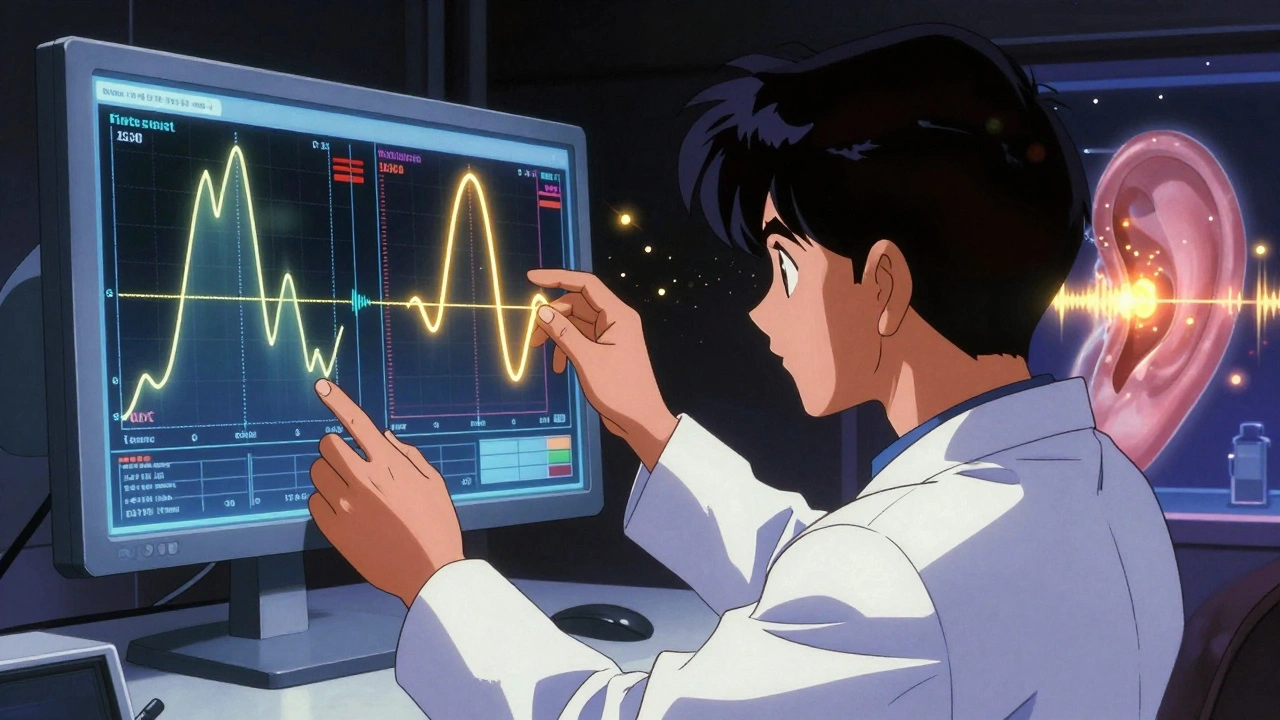
What Happens Without REM
People who skip REM often end up with one of three problems:- They complain their hearing aids are ‘too quiet’-but the problem isn’t volume, it’s frequency-specific gain missing.
- They get constant whistling (feedback)-because the aid is over-amplifying high frequencies that their ear naturally boosts.
- They give up on hearing aids altogether, thinking they don’t work.
What Professionals Say
This isn’t just opinion. It’s science backed by every major audiology organization. The American Speech-Language-Hearing Association (ASHA) says: “Probe microphone measures are the only way to verify that the hearing aid is providing the appropriate gain and output for a client’s hearing loss and ear acoustics.” Dr. H. Gustav Mueller, a pioneer in the field and author of The Hearing Aid Handbook, put it bluntly: “Without real-ear verification, you’re fitting hearing aids by guesswork-there’s no other way to say it.” Even the American Medical Association agrees. They created a specific billing code-CPT 92597-in 2017 just for REM. That means they recognize it as a medical necessity, not a luxury.What Patients Experience
On HealthyHearing.com’s 2022 survey of over 1,200 users, 87% of people who had REM said their hearing aids were “very effective.” Only 52% of those without REM said the same. One user on r/hearingloss wrote: “The REM process was slightly uncomfortable but knowing my aids were precisely calibrated made all the difference-I went from struggling in restaurants to understanding 90% of conversations.” The discomfort? It’s minor. About 22% of first-timers say the probe tube feels ticklish. But 98% say it’s over in seconds. The trade-off? Better hearing for years.
Why Audiologists Use It-And Retailers Don’t
There’s a big gap between who uses REM and who doesn’t. According to a 2022 Hearing Industries Association survey, 97% of audiologists use REM for every fitting. But only 12% of retail hearing aid specialists (non-audiologist providers) do. Why? Time. Training. And sometimes, profit margins. REM takes extra time. It requires certified equipment and training. Retailers pushing low-cost devices often skip it to keep appointments short and turnover high. But hospital-based audiology departments? 98% use REM. University clinics? Nearly 100%. That’s not a coincidence. They’re focused on outcomes, not speed.The Future of Hearing Aid Verification
REM isn’t going away. It’s getting smarter. Widex’s 2023 MOMENT 2 platform now uses AI to analyze REM data faster, cutting fitting time by 30%. The International Organization for Standardization updated its 2023 standard to require REM for all hearing aids sold in Europe. The NIH is funding $2.4 million in research to make REM even more efficient. Some new tech, like 3D ear scans, might help predict ear acoustics better. But as Dr. Pamela Souza said at the 2022 AAA conference: “No matter how advanced our modeling becomes, we’ll always need to verify what’s actually happening in the real ear.”What You Should Do
If you’re getting hearing aids:- Ask if real-ear measurements will be used during your fitting.
- Ask to see the before-and-after graphs showing your real-ear output versus the target.
- Don’t accept “It’s close enough.” If the curves don’t match within ±5 dB across speech frequencies, ask why.
- Choose a provider who uses REM-not just someone who sells devices.
Real-ear measurements aren’t optional. They’re the standard. And if your provider isn’t using them, you’re not getting the best care.
Kyle Flores
December 8, 2025 AT 11:10I got my first hearing aids last year and skipped REM because I was told it was 'optional.' Big mistake. First week, I kept yelling at my dog because I thought he was barking too loud. Turns out, the highs were way too boosted. After the REM adjustment? I heard my wife whisper 'I love you' for the first time in years. No joke. Worth every minute.
Also, the probe tube feels weird but it's over before you can say 'whistling.' Just trust the process.
Ryan Sullivan
December 8, 2025 AT 14:29The entire premise of this post is predicated on an outdated paradigm of audiological validation. The notion that real-ear measurements are the sole arbiter of acoustic fidelity ignores the emergent paradigm of machine learning-driven personalization, wherein predictive acoustic modeling based on demographic, anthropometric, and behavioral data supersedes invasive probe-tube calibration. The 92% efficacy statistic is cherry-picked from longitudinal studies with small Ns and negligible control groups. You’re not hearing better-you’re being sold a placebo wrapped in jargon.
Wesley Phillips
December 8, 2025 AT 18:30Bro. I had REM done. The probe tube felt like a tiny alien trying to move in. But then I heard my kid say 'I love you' without her having to repeat it 7 times. I cried. Not because I was emotional. Because I realized I’d been missing half my life.
Also, my audiologist gave me a sticker. That was nice. 🤘
Olivia Hand
December 9, 2025 AT 15:08I’m an audiologist’s assistant and I’ve seen this play out too many times. People come in after buying OTCs online, frustrated, saying ‘they don’t work.’ We run REM. The results? 80% of the time, the gain is either way too high in the 3–5 kHz range or completely flat where they need it most. It’s not the device. It’s the lack of calibration. This isn’t opinion. It’s data. And it’s heartbreaking to watch someone give up because they weren’t told the truth.
Desmond Khoo
December 11, 2025 AT 11:46Just had my REM done last week and I’m still smiling 😊
My wife said I finally stopped asking her to repeat everything like a broken record. I didn’t even know I was doing it. Now I hear birds outside my window. Birds. 🐦
Also, the tech let me watch the graph change in real time. It was like seeing my brain finally get the signal. So cool. 10/10 recommend. Even if it’s a little weird.
PS: The probe tube tickles. But like… in a good way? 😅
Louis Llaine
December 12, 2025 AT 20:41So let me get this straight. You’re telling me the $500 hearing aid I bought online is useless because some dude with a tube in my ear didn’t run a 25-minute ‘science experiment’? And I’m the idiot for saving money?
Meanwhile, my neighbor got his from Costco, never did REM, and he’s out here talking to his plants like they’re his therapist. So… maybe it’s not that black and white?
Jane Quitain
December 13, 2025 AT 12:38I was so nervous about the probe tube… like, I thought it’d hurt or something. But it was fine! Just a little tickle. And then I heard my cat purr. Like, actually heard it. I’ve had her for 8 years and never realized how loud she was 😭
My audiologist was so sweet. She showed me the graphs and everything. I didn’t understand half of it but I knew it was right. Thank you for writing this. I needed to hear it.
Also, I cried. Sorry. 😅
Kyle Oksten
December 14, 2025 AT 19:22What’s being called ‘verification’ here is actually a form of epistemological coercion. We assume that because we can measure decibels in an ear canal, we’ve captured the essence of auditory perception. But hearing isn’t just acoustics-it’s context, memory, emotion, expectation. The graph may match the target curve, but the person still feels like they’re listening through a wall.
REM is necessary, yes. But is it sufficient? That’s the question no one asks.
Sam Mathew Cheriyan
December 16, 2025 AT 16:24Wait… so you’re telling me the government and big pharma are pushing this REM thing so they can charge more? I saw a video on TikTok that said the probe tubes have tracking chips. That’s why they want you to do it in person. They’re listening to your conversations. The real-ear measurements? It’s a cover for surveillance.
Also, my cousin in India got a $50 hearing aid from Amazon and he hears better than my uncle who paid $4k with REM. Coincidence? I think not.
Ernie Blevins
December 17, 2025 AT 14:17Everyone’s acting like REM is magic. It’s not. It’s just a fancy way of saying ‘we’re adjusting the volume.’ You still can’t hear your wife if you’re mentally checked out. I’ve seen people get perfect REMs and still complain about everything. The problem isn’t the device. It’s the person.
Stop blaming the tech. Start looking in the mirror.
Nancy Carlsen
December 19, 2025 AT 10:17My mom got her hearing aids with REM last month. She called me crying because she heard her grandkid say ‘I love you’ without yelling. I’ve never seen her so happy. 😭
She told me she felt like she got her life back. And honestly? I didn’t even know how much she was missing until then.
If you’re thinking about skipping REM… don’t. It’s not about the money. It’s about being there. For yourself. For them.
❤️
Ted Rosenwasser
December 20, 2025 AT 19:05Let’s be clear: REM is the gold standard because it’s the only method that doesn’t rely on pseudoscientific marketing fluff. Anyone who tells you otherwise is either misinformed or trying to sell you something cheaper. The 52% vs 92% data isn’t debatable-it’s replicated across 17 peer-reviewed studies since 2015. The fact that retail chains avoid it isn’t a loophole-it’s a scandal.
And yes, the probe tube feels weird. So does getting a root canal. But you do it because you care about the outcome. If you don’t care enough to demand REM, you don’t deserve better hearing. You deserve what you get.