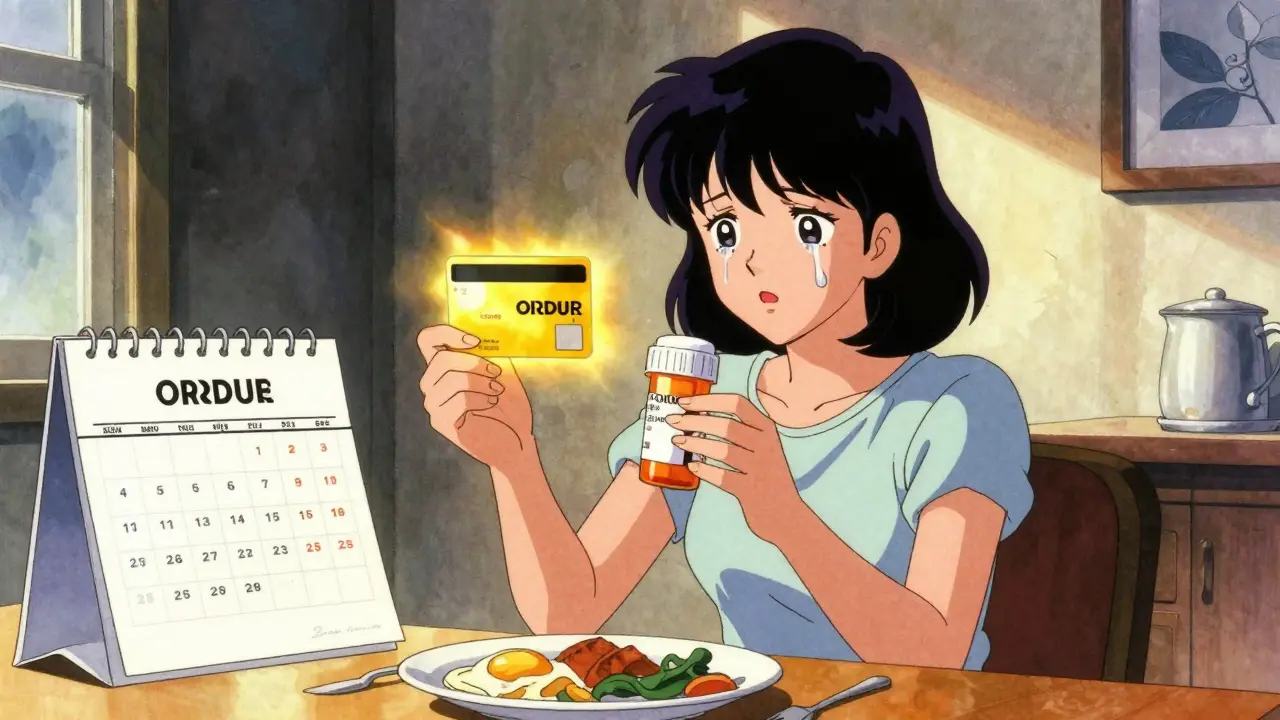
When you're prescribed a medication that costs hundreds of dollars a month, even with insurance, you might still be stuck paying hundreds out of pocket. That’s where prescription assistance programs come in. These aren’t government programs or charity drives-they’re direct offers from the drug companies themselves. Pfizer, Merck, Eli Lilly, and dozens of others run programs to help people afford the medicines they need. But not all programs are the same. Some help people with insurance. Others only help those without any coverage at all. And if you don’t know the difference, you could miss out on thousands in savings-or worse, end up paying more than you should.
Two Types of Help: Copay Cards vs. Patient Assistance Programs
There are two main kinds of manufacturer assistance programs, and they serve completely different groups.
Copay assistance programs are for people who have private health insurance. These usually come as a card or coupon you show at the pharmacy. The manufacturer pays part-or even all-of your copay. For example, if your prescription costs $400 and your plan says you owe $150, the copay card might cover $130 of that, leaving you with just $20. These are common for specialty drugs like those for rheumatoid arthritis, cancer, or asthma. In fact, 85% of specialty medications now offer some kind of copay card, according to the Kaiser Family Foundation.
But here’s the catch: many insurance plans now use copay accumulator programs. That means the money the manufacturer pays doesn’t count toward your deductible or out-of-pocket maximum. So even if you’re getting help, you’re still slowly climbing the same high cost hill. Some states, like California and New York, have passed laws to ban these accumulator programs, but in most places, they’re still legal.
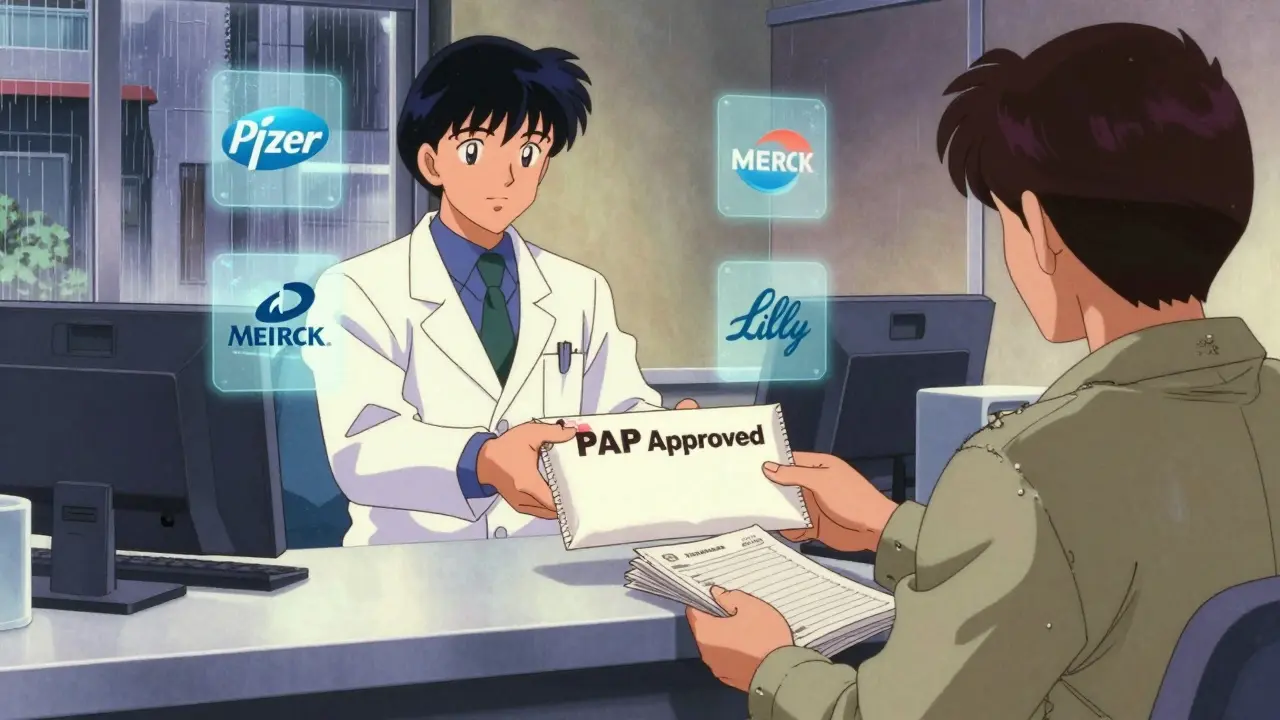
Patient Assistance Programs (PAPs) are for people without insurance-or with insurance that doesn’t cover their drug. These programs give you the medication for free or at a very low cost. You usually have to prove your income is below a certain level-often 200% to 400% of the Federal Poverty Level. For a family of four in 2023, that meant earning less than $60,000 a year. You’ll need to submit tax returns, pay stubs, or other proof. The application can take 45 to 60 minutes to complete. But once approved, you might get your medication delivered to your home for months or even years.
Who Gets Help? Who Gets Left Out?
You’d think these programs would help everyone who needs them. But reality is messier.
Medicaid and Medicare patients often can’t use manufacturer copay cards. Why? Because Medicaid programs in 78% of states ban them, fearing they push patients toward more expensive brand-name drugs instead of cheaper generics. And for Medicare Part D users, PAPs don’t count toward your true out-of-pocket costs (TrOOP). That means if you’re in the coverage gap-the “donut hole”-the free drugs from a PAP won’t help you get out of it any faster. You’ll still be stuck paying full price until you hit the catastrophic threshold.
Even worse, 62% of PAPs outright exclude people with any government insurance. So if you’re on Medicare or Medicaid, you might be ineligible for the very program meant to help you. That leaves millions of low-income seniors and disabled people with no safety net.
And then there’s the awareness problem. A 2022 survey found only 37% of eligible patients even knew these programs existed. Doctors don’t always bring them up. Pharmacies don’t always mention them. And if you’re overwhelmed by medical bills, it’s easy to miss the chance to save.
How Much Money Are We Talking About?
The numbers are staggering. In 2022 alone, pharmaceutical companies gave out $24.5 billion in patient assistance. That helped 12.7 million people. That’s more than the entire population of Australia.
For some, the savings are life-changing. A person on Dulera for asthma might pay as little as $15 per prescription with a copay card-down from $105. That’s $90 saved per fill. Twelve fills a year? That’s $1,080 in savings. For someone on a specialty drug like Humira, the savings can be $5,000 to $10,000 a year.
But here’s the dark side: researchers at JAMA Internal Medicine found these programs may be making drug prices worse. By lowering the cost for patients, manufacturers can keep prices high without pushback. And since insurers don’t see the full cost, they don’t negotiate harder. One study estimated copay assistance increased total drug spending by $1.4 billion a year. It’s a band-aid on a broken system.
How to Find and Apply for These Programs
You don’t need to guess which program might help you. There’s a tool built for this.
The Medicine Assistance Tool (MAT), run by PhRMA, is a free, confidential website that searches over 900 programs. Just enter your drug name, insurance status, and income. It shows you exactly which programs you qualify for, whether it’s a copay card, PAP, or something else.
For copay assistance:
- Go to the drug manufacturer’s website or search MAT
- Download or print the card
- Bring it to the pharmacy when you fill your prescription
- Some cards have monthly or yearly limits-check the fine print
For Patient Assistance Programs:
- Use MAT to find the right program
- Download the application form
- Gather proof of income (tax return, pay stubs, unemployment letter)
- Get your doctor to sign a form confirming medical necessity
- Mail or upload the application
- Wait 2-6 weeks for approval
Some programs, like Teva’s Cares Patient Assistance Program, offer certain generic drugs for free. Others, like Pfizer’s Pfizer Patient Assistance Program, cover brand-name drugs for people with no coverage.

The Bigger Picture: Are These Programs Helping or Hurting?
Supporters say these programs save lives. Dr. Jane Smith from the Brookings Institution says without them, over 2 million more Americans would skip their meds due to cost.
Critics say they’re a distraction. They let drug companies avoid lowering prices. They create a patchwork system that leaves out Medicaid and Medicare patients. And they don’t fix the root problem: drugs are too expensive.
Regulators are catching on. In 2024, 22 states passed laws to regulate or restrict copay assistance. California now requires companies to report how much they spend on these programs. The federal government is considering new rules to force more transparency.
And yet, demand keeps growing. Analysts predict the market for these programs will hit $38.2 billion by 2027. More people will need them. More companies will offer them. But unless drug pricing changes, we’ll keep patching the same holes.
What You Can Do Right Now
If you’re struggling to pay for prescriptions:
- Don’t assume you’re ineligible just because you have insurance. Check MAT anyway.
- If you’re on Medicare or Medicaid, call the manufacturer directly. Some programs have exceptions.
- Ask your pharmacist or doctor: “Is there a manufacturer program for this drug?”
- Apply even if you think you might not qualify. Income limits vary by program.
- Keep track of expiration dates. Some cards or PAPs need renewal every year.
These programs aren’t perfect. But for many people, they’re the only reason they can afford their medicine. Knowing how they work-and how to use them-could mean the difference between taking your pills and skipping them.
Can I use manufacturer copay assistance if I have Medicare?
You cannot use manufacturer copay cards to lower your costs if you’re on Medicare Part D. These cards are blocked by law from being applied to Medicare plans. However, you may still qualify for a Patient Assistance Program (PAP) if you have no other drug coverage, though most PAPs exclude Medicare beneficiaries. Always check directly with the drug manufacturer-some offer limited exceptions.
Do I need to reapply every year for a Patient Assistance Program?
It depends on the program. Some PAPs require annual re-enrollment-you’ll need to submit updated income documents each year. Others provide continuous coverage as long as you remain eligible. Always ask when you apply. Missing a renewal deadline can mean losing your medication, even if you still qualify.
Can I use copay assistance and a pharmacy discount card at the same time?
No. Most pharmacies will only accept one discount at a time. Manufacturer copay cards typically offer much larger savings (50-100%) than general discount cards (5-25%). Always use the manufacturer card if you’re eligible-it’s designed specifically for your drug and will save you far more.
Why don’t Medicaid and Medicare allow copay assistance?
State Medicaid programs and Medicare worry that copay assistance encourages patients to choose expensive brand-name drugs over cheaper generics. This can drive up overall drug spending for the program. As a result, 78% of states ban these cards for Medicaid recipients. Medicare doesn’t allow them because federal law prohibits third-party payments from counting toward Part D cost-sharing limits.
What if I make too much money for a PAP but still can’t afford my drug?
You may still qualify for other help. Some PAPs have sliding scales based on income, not strict cutoffs. Others offer partial discounts instead of free drugs. Also check nonprofit organizations like the Patient Access Network Foundation (PAN) or the HealthWell Foundation, which provide grants for copays and coinsurance. These are separate from manufacturer programs and often have different income rules.
Rachidi Toupé GAGNON
February 11, 2026 AT 11:37Just applied for my Humira copay card yesterday-got it approved in 2 days. My monthly bill dropped from $1,200 to $15. 😍 Life-changing. Don’t let anyone tell you it’s too hard. You got this!
Sophia Nelson
February 13, 2026 AT 04:27Yeah right. These programs are just corporate PR stunts. Drug companies make billions while pretending to care. Wake up.
Reggie McIntyre
February 14, 2026 AT 00:09Love that MAT exists. Found a PAP for my dad’s diabetes med-free for 18 months. But man, the paperwork? Brutal. Had to call 3 different offices, fax stuff, wait 3 weeks. Still worth it though. 🤞
Carla McKinney
February 14, 2026 AT 09:24Let’s be real-these programs are a band-aid on a gunshot wound. Pharma is gouging us, and this is just为了让公众觉得他们在做好事。It’s performative altruism. And don’t get me started on how they exclude Medicaid. This isn’t help-it’s manipulation.
Ojus Save
February 15, 2026 AT 10:16i use mat and it workd for my asthma med. but the website kept crashing. i had to try 5 times. also my doc didnt know about it. weird. but yeah saved me like 800 a year. ty internet.
Neha Motiwala
February 15, 2026 AT 11:19They’re lying. The government is in on it. These ‘programs’? They’re tracking you. Your name, your meds, your income-they’re feeding it to Big Pharma and the AI that controls your insurance rates. Next thing you know, your car insurance goes up because you used a copay card. I’m not joking. I’ve seen the leaks.
Alyssa Williams
February 17, 2026 AT 02:26You’re not alone. I’ve been there. Scared. Overwhelmed. Broke. But you can do this. One step at a time. Call the manufacturer. Fill out the form. Even if you think you don’t qualify-you might. You’re worth it. Keep going. 💪
Jack Havard
February 17, 2026 AT 11:07So let me get this straight. You’re telling me the same companies that price drugs at $500,000 a year are now our heroes because they give away 10% of it? That’s not charity. That’s math. They’re keeping prices high so they can offer ‘help’ and look good. Meanwhile, the rest of us pay the real cost. Classic.
Vamsi Krishna
February 18, 2026 AT 05:03Oh wow, so now we’re supposed to be grateful that pharmaceutical giants are playing nice? They’re not giving us anything. They’re just avoiding regulation. And don’t even get me started on how they use these programs to block generics. It’s a trap. You think you’re saving money, but you’re just locking yourself into their ecosystem.
Brad Ralph
February 20, 2026 AT 03:58So we’re celebrating a system where corporations decide who gets to live? Cute. 😏 At least they’re not charging us for oxygen yet. Next stop: insulin vending machines with QR codes.
christian jon
February 21, 2026 AT 08:10THIS IS A SCAM. I’VE SEEN IT. MY NEPHEW GOT APPROVED FOR A PAP-THEN THEY CUT OFF HIS MEDS BECAUSE HE GOT A PART-TIME JOB. THEY USE YOUR INCOME DATA TO HUNT YOU DOWN. THEY KNOW EVERYTHING. THEY’RE WATCHING. AND THEY’RE LAUGHING. YOU THINK THIS IS HELP? THIS IS CONTROL.
Autumn Frankart
February 22, 2026 AT 07:14Why do you think they allow this? Because they want you dependent. They want you to believe you need their help instead of demanding lower prices. They’re not helping you-they’re conditioning you. And now you’re thanking them for crumbs. Wake up. This is how they win.
Pat Mun
February 23, 2026 AT 07:02I’ve been helping people navigate these programs for over a decade. I’ve seen people cry when they get approved. I’ve seen them send thank-you notes. I’ve seen them live because of this. Yes, the system is broken. Yes, the corporations are profiting. But for the person who can’t afford their insulin? This matters. It’s not perfect. But it’s real. And it saves lives. Don’t let the cynics steal that from you.
Skilken Awe
February 25, 2026 AT 00:16Let’s not mince words: these programs are a regulatory arbitrage play. Manufacturers exploit loopholes in CMS guidelines to shift cost burden from payers to patients while maintaining premium pricing. The copay accumulator schemes? Purely designed to maximize revenue retention. And the PAP exclusion of Medicaid/Medicare? A deliberate structural exclusion to preserve margins. This isn’t charity. It’s financial engineering dressed in humanitarian clothing.