
Imagine feeling tired all the time, your joints ache for no reason, and you’ve lost interest in sex-not because you’re aging, but because your body is drowning in iron. This isn’t rare. In the UK and Ireland, about 1 in 83 people carry the genetic mutation that causes hemochromatosis. Yet most never know it until their liver is already damaged.
Hemochromatosis is not just high iron. It’s a genetic lock that won’t let your body stop absorbing iron from food. Every bite of steak, every spoon of fortified cereal, every glass of wine with a meal-your body treats it like a gift and hoards it. Over years, that iron piles up in your liver, heart, pancreas, and joints. Left untreated, it can lead to cirrhosis, diabetes, heart failure, or even liver cancer.
How Your Body Turns Against Itself
Normally, your body keeps iron in check. A hormone called hepcidin, made in the liver, tells your gut to slow down iron absorption when levels are full. In hemochromatosis, a mutation in the HFE gene-most often the C282Y version-breaks that signal. Without hepcidin, your intestines keep sucking up iron like a vacuum, even when you have more than enough.
Men start showing symptoms between 30 and 50. Women often don’t feel anything until after menopause, because monthly blood loss kept iron levels in check. By then, many have already lost 3 to 5 grams of iron-five times the normal amount. That’s like storing a full soda can’s worth of pure iron in your organs.
The signs are sneaky. Fatigue? Common. Joint pain, especially in your knuckles? Classic. Bronze or gray skin? That’s the iron staining your skin. Diabetes? That’s your pancreas being cooked from the inside. And if your doctor just says, “You’re stressed,” you might wait years for the right test.
Diagnosis: The Blood Tests That Save Lives
There’s no magic scan or fancy machine. Diagnosis comes down to two simple blood tests, done together:
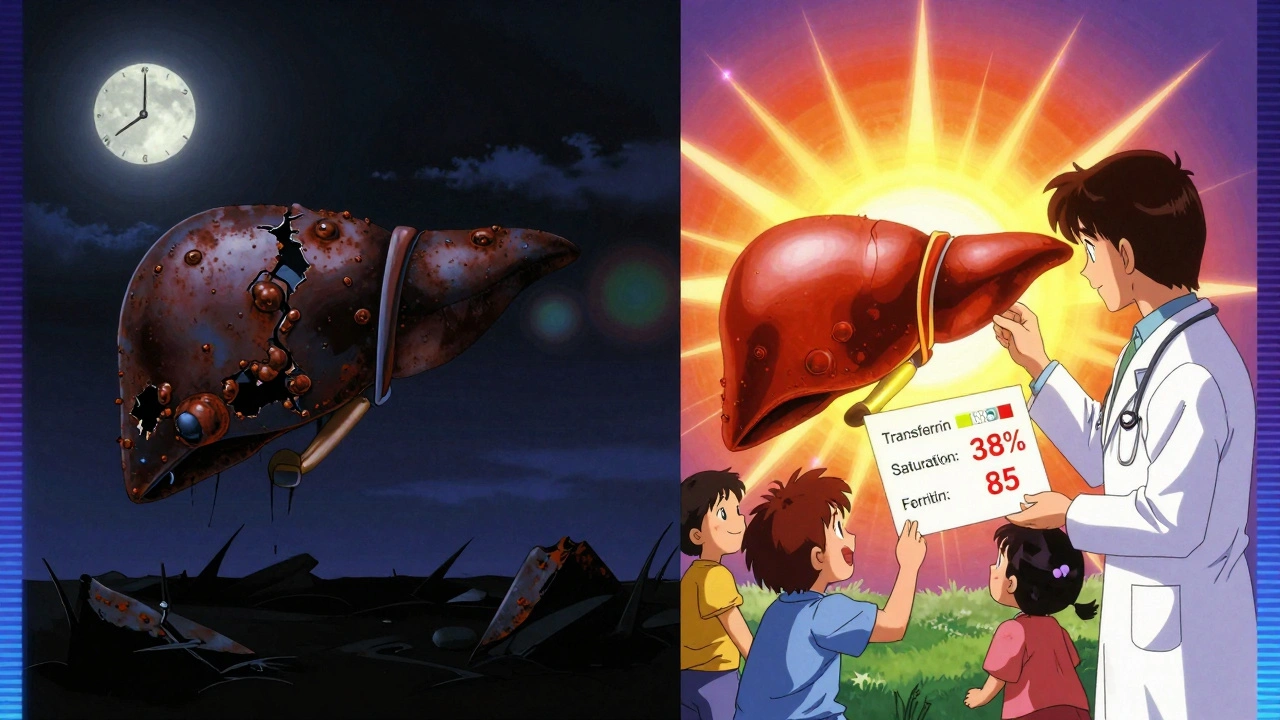
- Transferrin saturation: Above 45%? That’s your first red flag. This measures how much iron is floating in your blood, bound to transferrin. In hemochromatosis, it’s sky-high-even before ferritin rises.
- Serum ferritin: This is your body’s iron storage meter. Above 300 ng/mL in men, or 200 ng/mL in women? That’s a warning sign. If it’s over 1,000 ng/mL, your liver is already at high risk for scarring.
Confirm it with a genetic test for HFE mutations. C282Y homozygous means you have two copies of the faulty gene-this is the most common form, responsible for 80-95% of cases. H63D or S65C mutations? Less likely to cause trouble alone. But if you have C282Y and your ferritin is climbing, don’t wait.
Most people aren’t diagnosed until they’re in their 40s or 50s. One patient on Reddit spent eight years going to doctors, being told he had depression, until his ferritin hit 2,850. By then, he needed 62 phlebotomies just to get back to normal.
Phlebotomy: The Simple Treatment That Works
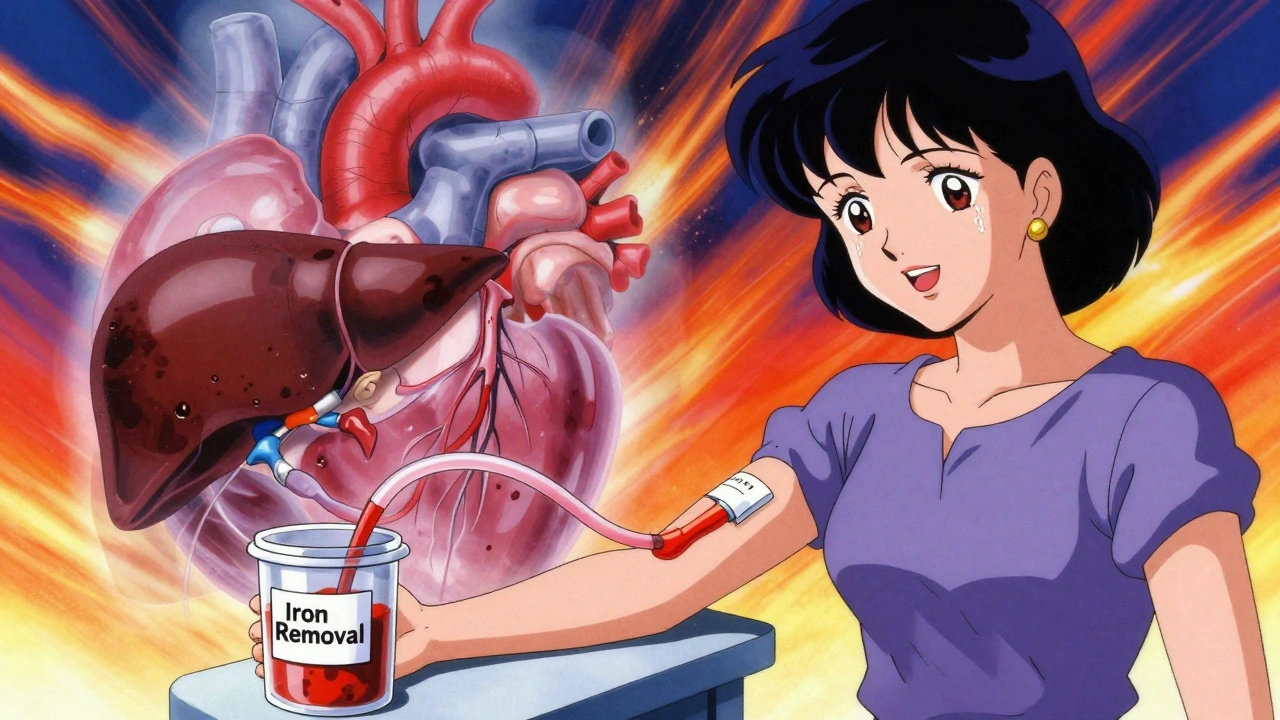
There’s no pill. No expensive drug. The best treatment for hemochromatosis is the same one used for blood donation: phlebotomy.
Every time you donate 450-500 mL of blood, you remove about 200-250 mg of iron. Your body doesn’t make new iron fast enough to replace it. So over time, your iron stores drop.
The process has two phases:
- Induction: Weekly blood draws until ferritin hits 50-100 ng/mL. For someone with ferritin over 1,000, this can take 12 to 18 months. That’s 30 to 50 sessions. It sounds exhausting-but it’s life-saving.
- Maintenance: Once iron is under control, you switch to every 2 to 4 months. Most people need 4 to 6 sessions a year for the rest of their lives. It’s not a cure, but it’s a shutdown. Iron stops building up. Organs stop getting damaged.
And it’s cheap. Each session costs $0 to $50 if covered by insurance. Compare that to iron-chelating drugs like deferasirox, which cost $25,000-$35,000 a year and come with kidney and liver risks. Phlebotomy doesn’t just treat the iron-it restores your energy, your joint function, your sex drive.
One patient in Bristol told me: “After my third phlebotomy, I slept through the night for the first time in five years. I didn’t know how tired I’d been.”
When Treatment Fails-and Why
Phlebotomy works brilliantly-if you stick with it. But three things can derail it:
- Advanced cirrhosis: If your liver is already scarred (Child-Pugh B or C), you can’t afford to lose more blood. You might need iron chelators instead, but they’re harder on your body.
- Heart iron overload: Iron in the heart can cause arrhythmias. In these rare cases, you need both phlebotomy and chelation, under specialist care.
- Stopping treatment: This is the biggest mistake. People feel better after a few sessions. They think they’re fixed. They quit. Then iron creeps back. Liver damage resumes. By the time they return, it’s too late.
Doctors see this over and over. A patient comes in with ferritin at 2,500, gets 40 phlebotomies, hits 80, feels great-and stops. Two years later, they’re back at 1,800. Their liver biopsy shows fibrosis. They didn’t need to wait. They just didn’t know.
What Happens If You Don’t Treat It
Untreated hemochromatosis doesn’t just cause symptoms. It changes your life expectancy.
If your ferritin is below 1,000 ng/mL when you start treatment, your 10-year survival rate is 95%. You live a normal lifespan.
If your ferritin is over 1,000? That drops to 60%. Why? Because iron has already started killing your liver. Cirrhosis sets in. Liver cancer risk jumps 20-fold. You might need a transplant.
And it’s not just the liver. Iron in the pancreas? Diabetes. Iron in the heart? Heart failure. Iron in the pituitary? Low testosterone, infertility, loss of libido. These aren’t side effects-they’re direct results of iron poisoning.
And here’s the kicker: 85% of people with hemochromatosis are never diagnosed. They’re labeled as “chronically tired,” “depressed,” or “just getting older.” Meanwhile, their organs are quietly failing.
Who Should Get Tested
You don’t need to wait for symptoms. If any of these apply to you, get tested:
- You have unexplained fatigue, joint pain, or erectile dysfunction
- Your liver enzymes (ALT, AST) are high for no clear reason
- You have type 2 diabetes without obesity
- You have heart problems with no known cause
- A close relative (parent, sibling, child) has hemochromatosis
Genetic testing now costs $150-$300-down from $1,200 in 2000. It’s faster, easier, and covered by many NHS pathways if your doctor orders it.
And if you’re diagnosed? Test your first-degree relatives. The Hemochromatosis Foundation says 70% of cases are found this way. One positive test in the family can save multiple lives.
What’s Next: New Hope on the Horizon
Phlebotomy works-but it’s not perfect. It’s time-consuming. It can be hard to find a clinic that does therapeutic draws. Some people can’t tolerate regular blood loss.
That’s why researchers are working on something better: hepcidin mimetics. These are synthetic versions of the hormone your body should be making. One drug, PTG-300, in Phase 2 trials, lowered transferrin saturation by 53% in 12 weeks. It’s not approved yet, but it’s the first real alternative to blood draws.
Another breakthrough? MRI scans can now measure liver iron without a biopsy. The R2* technique gives doctors a precise map of iron buildup-no needles, no risk. This means monitoring is safer, faster, and more accurate.
And scientists are now looking beyond HFE. New studies using 27 genetic markers can predict who will develop severe iron overload with 89% accuracy. That means we’ll soon be able to screen not just for the gene, but for the risk of damage.
Final Word: Don’t Wait for the Crisis
Hemochromatosis is one of the most treatable genetic diseases on earth. If caught early, it doesn’t shorten your life. It doesn’t stop you from working, traveling, playing with your kids, or enjoying a glass of wine.
But if you wait until you’re in pain, until your liver is scarred, until your blood sugar is out of control-you’re playing Russian roulette with your organs.
Ask your doctor for a transferrin saturation and serum ferritin test. If you’re over 30, tired all the time, and your joints ache-don’t brush it off. Get tested. It takes five minutes. The results could save your liver. Your heart. Your life.
Raja Herbal
December 8, 2025 AT 08:06So let me get this straight - we’re telling people to bleed themselves like vampires’ unpaid interns just to avoid turning into a rusty toaster? And this is cheaper than a monthly Netflix subscription? I’m sold. Also, why isn’t this on every damn doctor’s checklist after age 30? 🤡
Evelyn Pastrana
December 9, 2025 AT 22:00My uncle got diagnosed after he passed out at his grandson’s birthday party. He thought he was just ‘old and tired.’ Turns out his ferritin was over 3,000. He’s now on maintenance every 8 weeks and finally sleeps through the night. He even started gardening again. It’s wild how something so simple can give you your life back. 🌱❤️
Carina M
December 10, 2025 AT 04:29It is both lamentable and profoundly regressive that the medical establishment continues to rely upon a therapeutic modality that is, in essence, archaic - namely, the mechanical removal of whole blood - when one might reasonably expect that molecular interventions, grounded in contemporary biochemistry, would supplant such crude methodologies. One wonders if the pharmaceutical industry is complicit in this systemic inertia.
Maria Elisha
December 11, 2025 AT 20:02Ugh. I’m tired just reading this. Can we just take a pill instead? Like, why does everything have to be so… dramatic? I’m not getting my blood sucked out for a genetic thing I didn’t even know I had.
Angela R. Cartes
December 12, 2025 AT 02:51Okay but like… phlebotomy?? 😩 I mean, I get it’s cheap, but it’s so… 1980s. Also, why is everyone so chill about this? Like, imagine if your liver was slowly turning into a rusted nail and your doctor just said ‘eh, come back next Tuesday.’ 🤷♀️
Andrea Beilstein
December 13, 2025 AT 06:10Iron is just a metaphor for how we hold onto things we shouldn’t… the body knows when to let go but society tells us to keep absorbing… we’re all just hoarding energy like it’s scarce… maybe the real disease is our refusal to release what we think we need…
om guru
December 14, 2025 AT 05:02Early diagnosis saves organs. Transferrin saturation and serum ferritin are mandatory tests for individuals with unexplained fatigue or elevated liver enzymes. Family screening is non-negotiable. Delay equals irreversible damage. Act now.
Asset Finance Komrade
December 14, 2025 AT 10:14Interesting. But let’s not romanticize phlebotomy as some noble ritual. It’s a band-aid on a broken system. We’re treating symptoms while ignoring the root: why did evolution allow this mutation to persist? Is it a trade-off? Maybe it protected against parasites? Or is it just bad luck? 🤔
Jennifer Blandford
December 15, 2025 AT 22:42My sister got diagnosed after her doctor dismissed her joint pain as ‘just arthritis.’ She cried when she found out she had 5 grams of iron in her body. She’s been doing phlebotomy for two years now. Last week she hiked a mountain. She said she felt like a new person. Like… really new. Not just ‘less tired’ - like she remembered what joy felt like. 🌞❤️