Every year, millions of people in the U.S. switch from brand-name medications to generics - not because they have to, but because they can. And the savings? Often hundreds of dollars a month. Yet, confusion still lingers. Is a generic drug just a cheaper copy? Does it work the same? Is it safe? The truth is simpler than the myths suggest.
They’re the same medicine - just cheaper
Generic drugs aren’t imitations. They’re exact copies of brand-name drugs in every way that matters: the active ingredient, the dose, how fast it enters your bloodstream, and how well it works. The FDA requires generics to match the brand-name drug in strength, purity, stability, and performance. That means if you take 10 mg of generic lisinopril, it does the same thing as 10 mg of Zestril. Same chemistry. Same effect. Same safety profile. The only differences? The color, shape, or taste. Those are changed to avoid trademark infringement. The inactive ingredients - like fillers or dyes - might vary, but they don’t affect how the drug works. You’re not getting a downgrade. You’re getting the same medicine at a fraction of the cost.Why are generics so much cheaper?
Brand-name drug companies spend years and billions developing a new medicine. They run clinical trials, pay for FDA reviews, and market the product heavily. All of that gets baked into the price. Once the patent expires (usually after 12-14 years), other companies can make the same drug without repeating those expensive steps. Generic manufacturers only need to prove their version is bioequivalent - meaning it releases the same amount of active ingredient into your body at the same rate as the brand. That process costs a fraction of the original research. So while the brand might sell for $150 a month, the generic could cost $15. That’s not a discount. That’s a 90% savings.90% of prescriptions are generics - but they only cost 25% of what’s spent
Here’s the real eye-opener: in 2023, generics made up 90% of all prescriptions filled in the U.S. But they accounted for just 25% of total drug spending. That means brand-name drugs, which make up only 10% of prescriptions, are responsible for 75% of the money spent. Think about that. For every 10 prescriptions you pick up, nine are likely generics. But nine out of every ten dollars you spend on prescriptions? Probably going to the brand-name versions. The numbers don’t lie. According to the Association for Accessible Medicines, generics saved the U.S. healthcare system over $250 billion every year since 2017. That’s not a small number. That’s enough to cover millions of out-of-pocket costs for people on fixed incomes, seniors, and families struggling with chronic illness.When do generics not work as well?
Most of the time, they work perfectly. But there are exceptions. Some drugs have what’s called a narrow therapeutic index - meaning even tiny changes in blood levels can cause side effects or make the drug stop working. Drugs like warfarin (for blood thinning), levothyroxine (for thyroid), and some seizure medications like phenytoin fall into this category. For these, doctors sometimes recommend sticking with one version - brand or generic - to avoid any possible fluctuation. But here’s the catch: even for these drugs, the FDA requires tighter bioequivalence standards - between 90% and 111% - compared to the usual 80-125% for most drugs. A 2019 study in JAMA Internal Medicine followed 38,000 patients on levothyroxine and found no difference in outcomes between brand and generic versions. Still, some patients report feeling different after switching. A Reddit thread from 2023 had over 140 comments. Most said they noticed zero change. But about 14% reported issues - usually with seizure meds or thyroid drugs. In those cases, going back to the brand helped. That doesn’t mean generics are unsafe. It means some people are more sensitive to small changes, and consistency matters.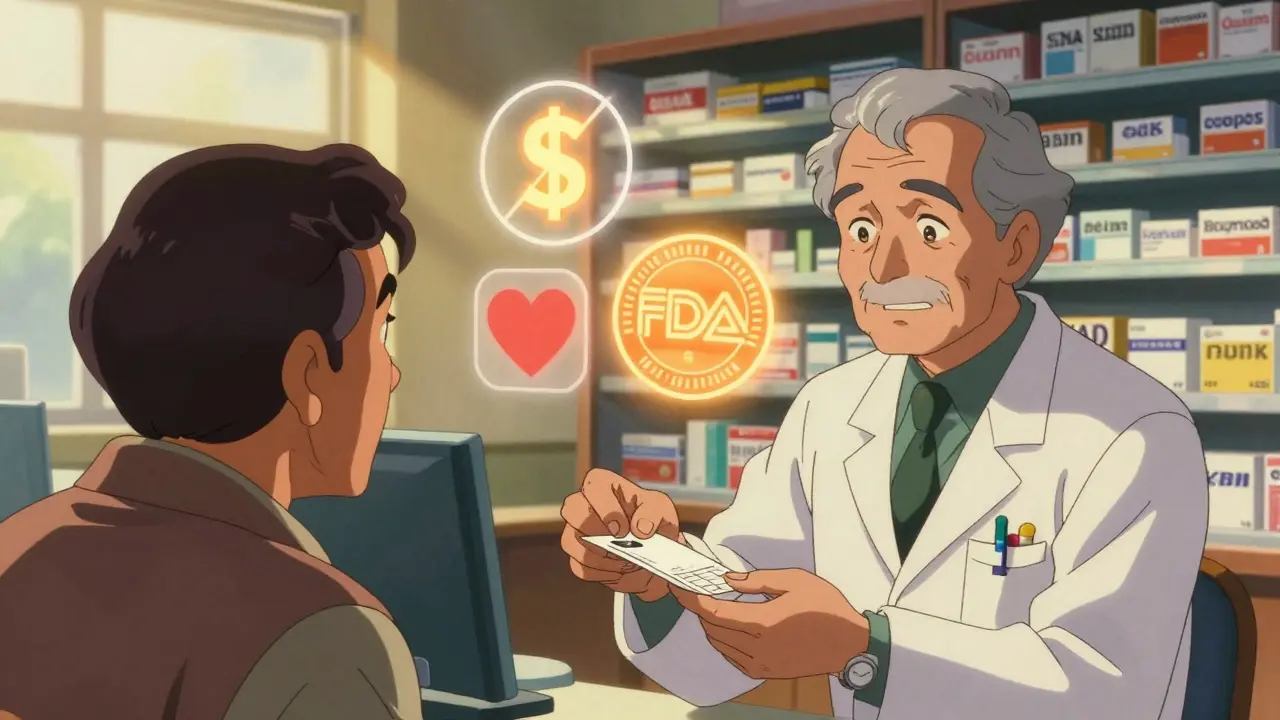
What the experts say
The FDA is clear: “All drugs, including brand-name and generic, must work well and are safe.” Pharmacists, doctors, and health organizations agree. The American Medical Association says physicians should prescribe generics when appropriate to cut costs without hurting outcomes. The American Pharmacists Association says generics are just as reliable. Even the Mayo Clinic and Harvard Health state that the vast majority of research shows no meaningful difference between brand and generic drugs. Dr. Henry C. Burgess, Chief Pharmacy Officer at University Hospitals, put it simply: “Generics must meet the same FDA standards for safety, quality, strength, purity, and efficacy as brand-name drugs.” So if your doctor says it’s okay to switch, they’re not cutting corners. They’re helping you save money without risking your health.How to make the switch
In 49 states, pharmacists are legally required to substitute a generic unless your doctor writes “dispense as written” on the prescription. That means if you don’t say otherwise, you’ll get the cheaper version. Here’s what to do:- Ask your doctor if a generic is available and appropriate for your medication.
- Check your prescription label. Generic names are often listed in parentheses - like “metformin (Glucophage)”.
- Keep a list of your meds, including both brand and generic names. This helps avoid confusion if you switch pharmacies or refill at a different location.
- If you notice a change in how you feel after switching, talk to your pharmacist or doctor. Don’t assume it’s all in your head.
What about biosimilars?
If you’ve heard about “biosimilars,” that’s a different category. These are generic versions of biologic drugs - complex medicines made from living cells, like Humira or Enbrel. They’re not exact copies like traditional generics because biologics are too intricate to replicate perfectly. But they’re proven to be just as safe and effective. The FDA has approved dozens of biosimilars since 2015, and they’re starting to bring down prices for expensive treatments like rheumatoid arthritis and cancer therapies.
Why aren’t all drugs generic?
About 30% of brand-name drugs still don’t have generic versions. Why? Two main reasons:- Patents still active. Some drugs are protected for years - especially newer ones for rare diseases or complex conditions.
- Manufacturing is too hard. Some pills, inhalers, or topical creams are incredibly difficult to copy. Think of it like trying to recreate a luxury watch with off-the-shelf parts. The FDA calls these “complex generics,” and there are about 150 on their priority list.
Real savings, real impact
A 2022 survey by Consumer Reports found that 89% of people believe generics are just as effective as brand-name drugs. In Pharmacy Times’ 2023 survey, 92% of patients said they preferred generics when available - mostly because of cost. One user on Reddit saved $400 a month switching from brand-name Advair to generic fluticasone/salmeterol - with no loss in asthma control. Another saved $313 per prescription on average, according to University Hospitals data. These aren’t hypothetical numbers. They’re real savings that let people afford their meds month after month. For someone on insulin, statins, or blood pressure pills, that’s the difference between taking their medicine - and skipping doses because they can’t pay.Bottom line: Choose generic unless told otherwise
There’s no reason to pay more for the same medicine. Generics are rigorously tested. They’re monitored. They’re safe. And they save billions every year. If your doctor hasn’t said “do not substitute,” let your pharmacist give you the generic. If you’re worried, ask for the FDA’s Orange Book - it lists every approved generic equivalent. You can even check it yourself online. You’re not compromising your health. You’re just being smart with your money.Are generic drugs as safe as brand-name drugs?
Yes. The FDA requires generic drugs to meet the same strict standards for safety, strength, quality, purity, and performance as brand-name drugs. Every generic must prove it delivers the same amount of active ingredient into your bloodstream at the same rate. There’s no difference in safety profiles.
Why do generics look different from brand-name drugs?
U.S. trademark laws prevent generic drugs from looking exactly like brand-name versions. So manufacturers change the color, shape, size, or packaging. But the active ingredient - the part that treats your condition - is identical. The differences are only cosmetic.
Can I switch from a brand-name drug to a generic without my doctor’s approval?
In most cases, yes - but only if your doctor didn’t write “dispense as written” on the prescription. Pharmacists are legally allowed to substitute a generic unless the prescription specifically forbids it. Still, it’s always a good idea to talk to your doctor first, especially if you’re on a medication with a narrow therapeutic index.
Do generics take longer to work?
No. To get FDA approval, a generic must be bioequivalent - meaning it enters your bloodstream at the same rate and to the same extent as the brand-name drug. Studies show no meaningful difference in how quickly generics start working.
Why do some people say generics don’t work for them?
A small number of patients - usually those on narrow therapeutic index drugs like levothyroxine or seizure meds - report feeling different after switching. This may be due to slight variations in inactive ingredients or individual sensitivity. But large studies show no clinical difference in outcomes. If you notice a change, talk to your doctor. You may need to stick with one version for consistency.
Will my insurance cover generics?
Almost always - and at a much lower cost. Most insurance plans have lower copays for generics. Some even require you to use the generic version before covering the brand-name drug. Out-of-pocket costs for generics average $12.50 per prescription, compared to $68.30 for brand-name drugs with insurance.
Abner San Diego
January 11, 2026 AT 01:18Generics? Yeah right. My cousin took some generic blood pressure stuff and ended up in the ER. They’re just cheap knockoffs with filler from China. Why would you trust your life to some factory that can’t even spell ‘pharmaceutical’ right?
Eileen Reilly
January 11, 2026 AT 14:22ok so i switched my advair to the generic and like?? saved like 300 a month?? and honestly?? i didnt even notice a difference?? like i still dont wheeze?? idk why ppl make this a thing??
Jennifer Phelps
January 12, 2026 AT 02:59I’ve been on levothyroxine for 12 years and switched from Synthroid to generic twice. First time I felt sluggish for two weeks. Second time? Nothing. I think it’s about consistency. If you switch back and forth, your body gets confused. Stick with one. Generic is fine if you don’t bounce around pharmacies.
Rinky Tandon
January 12, 2026 AT 19:24Let me break this down for you. The FDA’s bioequivalence standard is 80-125% which is a 45% variance. That’s not a drug. That’s a lottery. In India, we don’t even allow such lax standards for veterinary medicine. You’re gambling with your endocrine system. And don’t get me started on the fillers-phthalates, talc, gluten derivatives-hidden in generics to cut costs. Your ‘savings’ are poisoning you slowly.
Ben Kono
January 13, 2026 AT 16:13My pharmacist switched my metformin without telling me and I started getting diarrhea like crazy. Turned out the generic had a different binder. I went back to brand. Worth every penny. Don’t let them pull this crap on you.
Cassie Widders
January 15, 2026 AT 15:48My mum’s on statins. She’s been on the generic for five years. No issues. Saves her $200 a month. She says it’s like buying the same cereal in a plain box. Why pay extra for the cartoon on the front?
Konika Choudhury
January 16, 2026 AT 13:33USA thinks generics are magic but in India we know the truth. Many generics are made in shoddy labs with expired chemicals. You think your blood pressure pill is safe? Maybe it’s just sugar with a logo. The FDA is just a marketing tool for Big Pharma. Don’t be fooled.
Windie Wilson
January 18, 2026 AT 06:45Wow. So the government says generics are fine. And the doctors say they’re fine. And the pharmacists say they’re fine. And yet somehow, every time I switch, I feel like I’ve been replaced by a slightly slower version of myself. Maybe the real difference isn’t in the pill… it’s in the placebo effect of paying more. Or maybe I’m just a rich person who likes feeling like I’m getting what I paid for. Either way, I’ll keep buying the blue capsule with the gold lettering. It makes me feel like I’m not a bargain bin citizen.