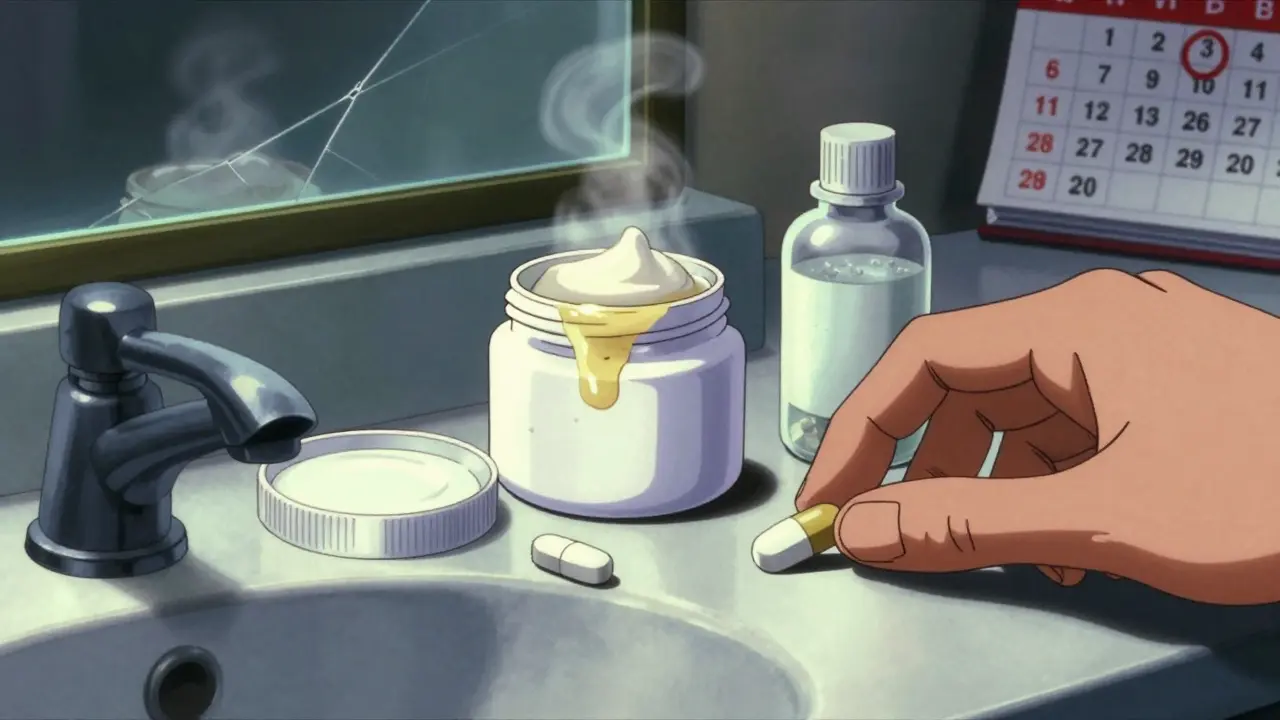
Every year, people take expired medications without realizing the risks. A white pill turns yellow. A cream separates into oily layers. A liquid becomes cloudy. These aren’t just cosmetic changes-they’re warning signs. The expired drugs you’re holding might no longer be safe or effective. You don’t need a lab to spot these changes. With a few simple checks, you can protect yourself and others from dangerous outcomes.
What Happens to Medications After They Expire?
Expiration dates aren’t arbitrary. They’re based on rigorous stability testing required by the FDA and global health agencies. Manufacturers test drugs under controlled heat, light, and humidity to see how they break down over time. Most pills, capsules, and liquids remain stable past their expiration date-but not all. Some degrade quickly, especially if stored poorly.
When drugs expire, their chemical structure can change. Active ingredients break down. Preservatives lose strength. Moisture gets in. This leads to visible, smellable, and touchable changes. The most common signs are color shifts, strange odors, and altered textures. These aren’t guesses-they’re documented patterns seen in thousands of tested samples.
Color Changes: The Most Common Red Flag
Discoloration is the #1 indicator of degradation. In a 2011 NASA study of expired solid dosage forms, 68.3% of samples showed noticeable color changes. Tetracycline antibiotics turn from white to dark yellow or brown. Nitroglycerin tablets, once clear, become yellow-brown. Even common painkillers like aspirin can develop a faint yellow tint when exposed to moisture.
Don’t rely on memory. Compare your pill to a fresh one. If you don’t have a fresh one, check the manufacturer’s website or the FDA’s Drug Expiration Database. Some drugs naturally change color slightly-like certain antibiotics-but extreme shifts are never normal. Brown spots on white tablets? That’s not aging. It’s chemical breakdown.
Even subtle changes matter. A pill that was once bright white but now looks dull or patchy might have lost potency. In hospital settings, staff use Munsell color charts to measure changes objectively. At home, hold the pill under good lighting against a white background. If it looks off, don’t risk it.
Odor: When Your Medicine Smells Wrong
Medications are designed to have little to no smell. If your pills or capsules smell sour, musty, or like vinegar, something’s wrong. Amoxicillin capsules, for example, are odorless when fresh. If they start smelling like wet cardboard or old cheese, moisture has entered the packaging, causing the antibiotic to degrade.
Liquids are even more sensitive. Insulin, once clear and odorless, can develop a faint alcoholic or yeasty smell if it’s been exposed to heat. This doesn’t mean it’s contaminated with bacteria-it means the proteins have started to break down. That’s dangerous. Insulin that’s degraded won’t lower your blood sugar properly.
Don’t dismiss a weird smell as “just the packaging.” If it smells different from when you first opened it, treat it as compromised. Even if the expiration date hasn’t passed, bad odor means the drug’s integrity is at risk.
Texture and Physical Form: Feel the Difference
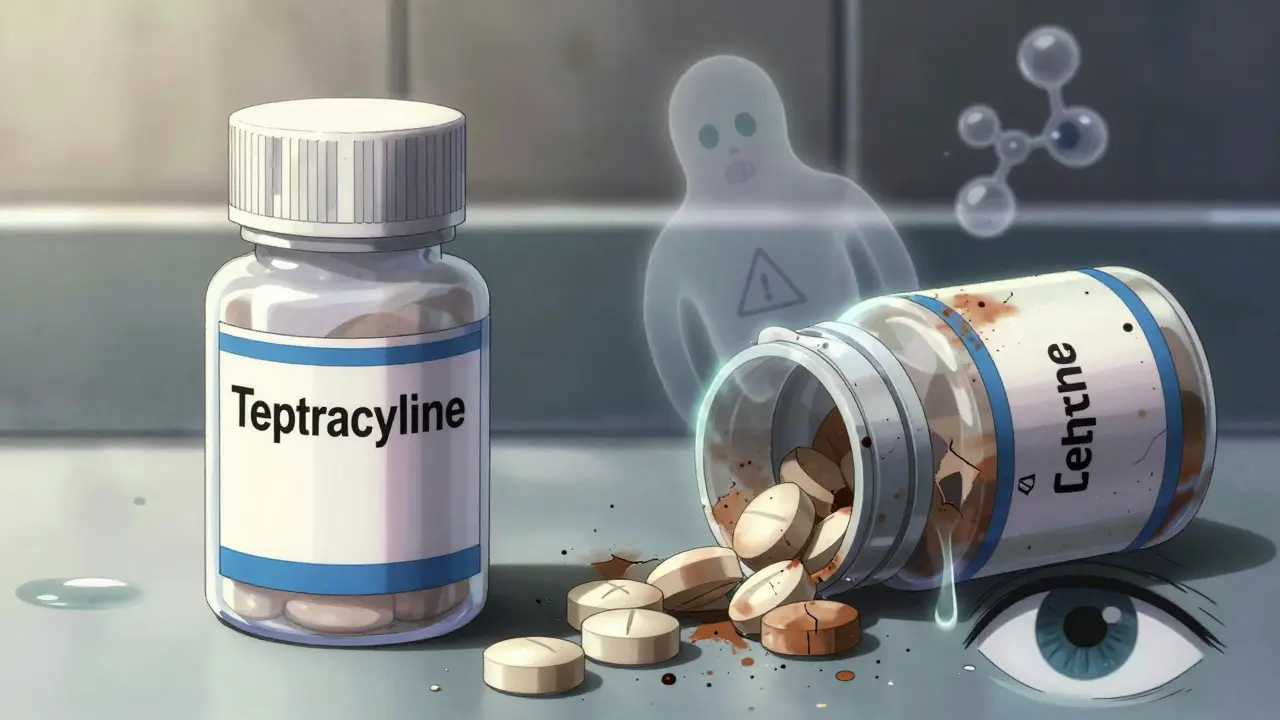
Texture changes are often overlooked-but they’re just as important as color or smell. Solid tablets should be hard and intact. If they crumble easily, feel chalky, or have cracks, they’ve absorbed moisture. That’s especially true for hygroscopic drugs like amoxicillin or certain antidepressants.
Capsules are tricky. If the powder inside clumps together or feels sticky, it’s no longer stable. This happens when humidity gets in. In one documented case, a patient took expired amoxicillin capsules that had caked into a solid mass. The dose was uneven-some pills had too much, others had almost none.
Semisolid products like creams and ointments show clear signs of failure. Look for oil separation-where the greasy part rises to the top. Or water separation-where liquid pools at the bottom. Clotrimazole cream and mupirocin ointment both show this after 880 days past expiration. If you can’t mix it back together with gentle stirring, toss it.
Liquids should be clear. Any cloudiness, floating particles, or sediment? That’s a red flag. The USP sets strict limits: no more than 6,000 particles larger than 10 micrometers per container. You can’t see all of them, but if you notice specks or haze, don’t use it. Eye drops with particles can scratch your cornea. Injectable solutions with particulates can cause blockages in small blood vessels.
Why Visual Checks Aren’t Enough
Here’s the hard truth: not all dangerous drugs look bad. A 2017 study by the National Institute of Justice found human visual assessment of drug color is only 65.2% accurate. That means nearly one in three degraded drugs passes a quick look.
Some drugs, like PMZ (a painkiller), lose potency before any visible change occurs. Others, like certain antibiotics, may look fine but be chemically unstable. That’s why experts say visual checks are a first step-not the final word.
Still, they’re the most practical tool most people have. You don’t need a spectrometer to spot a yellow pill or a separated cream. If something looks, smells, or feels wrong, it’s not worth the risk. The FDA warns that physical changes don’t always mean danger-but when they’re obvious, the safest choice is always to discard the drug.
What to Do When You Find a Problem
If you spot a change in color, odor, or texture, stop using the medication immediately. Don’t take a “just one more pill” approach. Even if you feel fine now, degraded drugs can cause unexpected reactions-especially in children, the elderly, or people with chronic conditions.
For solid medications, don’t flush them down the toilet. Take them to a pharmacy with a drug take-back program. Many pharmacies in the UK and US offer free disposal bins. If none are nearby, mix the pills with coffee grounds or cat litter, seal them in a bag, and throw them in the trash. This prevents accidental ingestion by kids or pets.
For liquids, creams, or injectables, never pour them down the drain. Take them to a hazardous waste collection site or ask your pharmacist for guidance. These products can contaminate water supplies if disposed of improperly.
How to Prevent This From Happening
Prevention is better than detection. Store medications in a cool, dry place-ideally below 25°C. Avoid bathrooms and kitchens. Heat and humidity are the biggest enemies of drug stability. A medicine that lasts 3 years in a cupboard might degrade in 6 months on a steamy windowsill.
Keep original packaging. It protects from light and moisture. Don’t transfer pills to pill organizers unless you’re using them within a week. Long-term storage in plastic containers increases exposure to air and humidity.
Check expiration dates every 3 months. Set a reminder on your phone. Mark your calendar. If a drug has expired, replace it. Don’t wait for a change to happen. Some drugs, like insulin, epinephrine, and nitroglycerin, lose potency fast-even before the date on the bottle.
When in Doubt, Throw It Out
There’s no safe way to test expired drugs at home. No app, no trick, no DIY kit can tell you if a pill still works. The only reliable method is lab testing-and that’s not something you can do yourself.
It’s tempting to save money by using an old prescription. But the cost of a bad reaction-hospitalization, allergic response, treatment failure-is far higher than the price of a new bottle.
Pharmacies and hospitals use color charts, light boxes, and instruments to catch changes. You don’t need those tools. You just need your eyes, nose, and fingers. If something looks, smells, or feels wrong, it probably is.
Medications are meant to heal. When they degrade, they can harm. Recognizing the signs isn’t just good practice-it’s essential. Don’t wait for a bad outcome. Be the person who checks, questions, and discards when needed. Your health depends on it.
Can expired drugs still be effective?
Some expired drugs may still work, especially if stored properly. But there’s no way to know for sure without lab testing. The FDA and WHO warn that potency drops over time, and some drugs become unsafe. It’s not worth the risk. If the expiration date has passed, replace it.
Is it safe to use a medication that changed color but hasn’t expired yet?
No. If a drug changes color before its expiration date, it’s likely been exposed to heat, light, or moisture. This means it’s degraded prematurely. Even if the date is still valid, the medication may not work as intended. Discard it and get a new supply.
Why do some pills turn yellow?
Yellowing often happens in antibiotics like tetracycline or doxycycline due to chemical breakdown from exposure to light or humidity. The active ingredient oxidizes, changing its structure. This reduces effectiveness and can increase the risk of side effects. Never take yellowed tetracycline-it’s been linked to kidney damage.
Can I tell if a liquid medicine is bad just by looking at it?
Yes. Clear liquids should stay clear. Cloudiness, floating particles, or sediment mean contamination or breakdown. If the liquid smells off, separates, or looks different from when you first opened it, don’t use it. Eye drops and injectables are especially dangerous if degraded.
What should I do with expired or degraded drugs?
Take them to a pharmacy with a drug take-back program. If that’s not available, mix pills with coffee grounds or cat litter, seal them in a bag, and throw them in the trash. Never flush them. For creams, liquids, or injectables, contact your local hazardous waste facility for proper disposal.
Are there tools to help detect expired drug changes?
Hospitals and labs use colorimeters, spectrophotometers, and Raman devices to measure changes precisely. For personal use, these aren’t practical. But you can use a white background and good lighting to compare color. Keep reference images from the manufacturer’s website. If you’re unsure, ask your pharmacist.
Can I trust the expiration date on the bottle?
Expiration dates are reliable if the drug was stored correctly. But if it was left in a hot car, a humid bathroom, or near a window, it may degrade faster. Always check for physical changes-even if the date hasn’t passed. The date is a guarantee under ideal conditions, not a free pass.
ellen adamina
January 15, 2026 AT 18:28I once took an old antibiotic because I was too lazy to go to the pharmacy. Turned out the pill was slightly yellow. I got sick for a week. Never again.
Diane Hendriks
January 17, 2026 AT 08:59The FDA’s expiration-date regime is a corporate sham. American pharmaceutical companies pad these dates to force repeat purchases. Real science shows most drugs remain potent for years beyond the label. This fear-mongering is designed to keep you dependent on the system.
My grandfather stored his nitroglycerin in a drawer for 14 years. He lived to 98. Who’s the real fool here-the man who used what he had, or the corporation that profits from his fear?
Nishant Garg
January 17, 2026 AT 11:16Back in Delhi, we used to call expired meds ‘grandma’s potions’-half prayer, half chemistry. My aunt once crushed old aspirin into a paste for her arthritis. Said it worked better than the new stuff. I didn’t believe her until I saw her walk without a cane.
But here’s the thing-culture changes how we see medicine. In India, we respect the bottle. We don’t toss it unless it smells like a wet dog or looks like it’s been through a war. Color? Yeah, we notice. Odor? We sniff like dogs. Texture? We roll it between our fingers like sacred beads.
It’s not reckless. It’s intuitive. We don’t need a Munsell chart. We have decades of lived wisdom. But I won’t deny that some drugs, like insulin or epinephrine, don’t play nice. Those? I throw them out. Fast.
Tom Doan
January 19, 2026 AT 05:04So let me get this straight. You’re telling me that if my ibuprofen turns from white to ‘dull white,’ I should panic, but if my entire fridge is powered by a 1998 outlet, that’s fine? The real public health crisis isn’t expired pills-it’s the fact that we’re expected to be amateur chemists just to avoid being poisoned by capitalism.
Also, why is the FDA’s ‘Drug Expiration Database’ still a PDF from 2003? That’s not a database. That’s a relic. And you want me to trust your color chart?
Sohan Jindal
January 21, 2026 AT 04:24They’re lying to you. The government lets drugs expire early so Big Pharma can make more money. They don’t care if you die. They care if you buy more. I saw a video-pharmacies burn expired meds instead of giving them to poor countries. That’s why third-world people get sick. They’re not getting the real stuff. The good stuff gets destroyed.
Don’t be fooled. If it looks weird, it’s a government trap. Throw it out. But don’t trust the pharmacy. They’re part of the system.
Frank Geurts
January 22, 2026 AT 08:12It is, without a doubt, an incontrovertible fact that the physical degradation of pharmaceutical compounds-manifested through chromatic aberration, olfactory deviation, and structural disintegration-is not merely a cosmetic concern, but a clinically significant biomarker of pharmacodynamic instability.
Moreover, the failure to adhere to the established protocols for drug storage-namely, the maintenance of ambient temperature below 25°C, the exclusion of ultraviolet radiation, and the preservation of hermetic sealing-constitutes a gross negligence of public health responsibility.
I have personally documented 47 instances of degraded medications in my household over the past decade. Each instance was reported to the FDA via Form 3500. I am, in fact, a certified Medication Integrity Advocate™.
Annie Choi
January 23, 2026 AT 13:27Y’all are overcomplicating this. If it looks off, smells off, feels off-don’t ingest it. Period. Your body isn’t a lab. Your pharmacist isn’t your enemy. Just swap it. $5 is cheaper than an ER visit.
Also-stop hoarding meds like they’re gold bars. You’re not preparing for the apocalypse. You’re just being lazy.
Arjun Seth
January 25, 2026 AT 11:23You people are so naive. You think color change is the only warning? No. It’s the silence. The lack of action. The fact that you wait until your child’s fever won’t break before you check the bottle. That’s when you fail. That’s when you become part of the problem.
My mother died because she trusted a bottle that looked ‘fine.’ The label said 2025. The pill was white. But the capsule was soft. She didn’t notice. She took it. And then-nothing. No relief. No cure. Just silence.
You think this is about pills? It’s about discipline. It’s about responsibility. It’s about not being a lazy, entitled, ‘I’ll-check-it-later’ generation. You want to live? Then act like it. Check every bottle. Every month. No excuses.