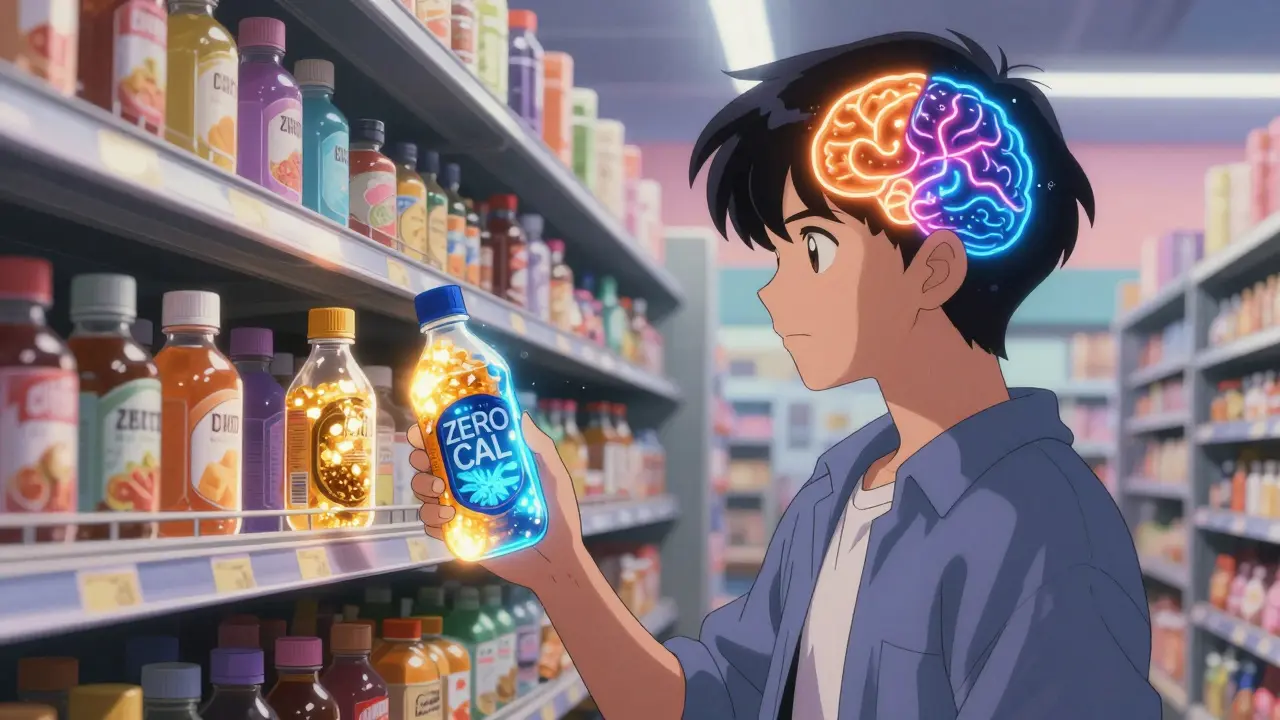
It’s 2026, and you’re standing in the grocery aisle, staring at two bottles: one with sugar, the other labeled "zero calorie." You want to cut back on sugar, so you grab the diet version. But a few hours later, you’re snacking on cookies you didn’t plan to eat. Why? The answer isn’t simple. Sugar vs. artificial sweeteners isn’t just about calories-it’s about your brain, your hormones, and your cravings.
What Happens When You Swap Sugar for Sweeteners?
Sugar gives you energy. Your body breaks it down into glucose, which triggers insulin release and tells your brain, "You’ve eaten something real." Artificial sweeteners? They’re chemical imitations-200 to 600 times sweeter than sugar, but they don’t break down into glucose. That’s the problem. Studies show that when your brain tastes sweetness but doesn’t get the expected calories, it gets confused. A 2023 study from the University of Southern California found that sucralose, the main ingredient in Splenda, doesn’t trigger the release of GLP-1, a hormone that tells you you’re full. Participants reported 17% higher hunger levels after drinking a sucralose-sweetened beverage compared to one with sugar. And it wasn’t just about hunger-it was about brain activity. fMRI scans showed that sucralose changed how the hypothalamus (your brain’s hunger center) talked to the part of the brain that controls reward and decision-making. But here’s the twist: not all sweeteners act the same. A 2022 trial from the University of Leeds found that when people swapped sugar for artificial sweeteners, their appetite didn’t spike. In fact, insulin and blood sugar levels dropped by 18% and 15%, respectively. So why the contradiction? The answer lies in duration and individual biology.Short-Term vs. Long-Term Effects
If you switch from soda to diet soda for a week, you might feel fine. Maybe even better. Your blood sugar stays stable. You’re saving 150 calories a day. That’s a win. But what if you do it for six months? A 2024 study from the German Center for Diabetes Research showed something unsettling: after three months of daily sucralose use, people started craving sweeter foods. Their brains had recalibrated. The same thing happened in a 2016 University of Sydney study with fruit flies-after five days of sucralose, they ate 30% more calories when given real sugar. The brain learned: "Sweet = no energy." So it started demanding more sweetness to feel satisfied. This isn’t just theory. A 2023 survey by Healthline of 2,300 adults found that 63% of people who used artificial sweeteners daily for over six months reported stronger hunger pangs and more frequent cravings. The worst offenders? Diet sodas with aspartame and acesulfame potassium. People who switched to stevia or monk fruit reported fewer issues.Sex Differences Matter
Women are not just smaller versions of men when it comes to metabolism. A 2023 USC study found that women showed 40% greater brain activity changes in response to sucralose than men. Their hypothalamus reacted more intensely, and their hunger signals were louder. This might explain why women are more likely to report increased cravings after switching to diet products. It’s not about willpower. It’s biology. Your brain is wired to link sweetness with energy. When that link breaks, it doesn’t just ignore it-it tries to fix it by pushing you to eat more.
What the Data Really Says
Let’s cut through the noise. Some studies say sweeteners help you lose weight. Others say they make you gain it. Both are right-depending on context. A 2021 meta-analysis of 15 randomized trials found that replacing sugar with artificial sweeteners cut daily calorie intake by 112 kcal on average. That’s about 12 pounds a year-significant if you’re trying to lose weight. But here’s the catch: that benefit disappeared in long-term users. In people who’d been on sweeteners for over a year, the calorie reduction vanished. Their bodies compensated. They ate more at meals. They snacked more. The sweeteners didn’t stop cravings-they just moved them around. And it’s not just about quantity. It’s about quality. People who use sweeteners often replace sugary snacks with other processed foods-diet yogurt, sugar-free protein bars, flavored waters. These aren’t nutrient-dense. They’re still hyper-palatable. And your brain still wants more.What Works Better Than Sweeteners
If sweeteners aren’t the magic fix, what is? First, don’t go cold turkey. A 2022 clinical trial from the SWEET project found that people who switched from sugar to sweeteners needed 2-3 weeks to adjust. During that time, 38% reported worse cravings. Then they stabilized. The key? Don’t quit sugar cold. Reduce it slowly. Swap one soda a week for water. Then two. Then replace your afternoon candy bar with a piece of fruit. Second, pair sweeteners with protein. A 2021 study showed that when people ate a sweetener-sweetened yogurt with added protein, hunger dropped by 22% compared to the same yogurt without protein. Protein slows digestion. It triggers satiety hormones. It tells your brain, "This meal counts." Third, try natural low-intensity sweeteners. Stevia and monk fruit are 200-300 times sweeter than sugar-not 600. That means they’re less likely to overload your taste receptors and confuse your brain. In Amazon reviews, stevia-based products like Truvia have 4.2 stars with only 15% of negative reviews mentioning cravings. Splenda? 3.8 stars, with 28% of complaints about increased hunger.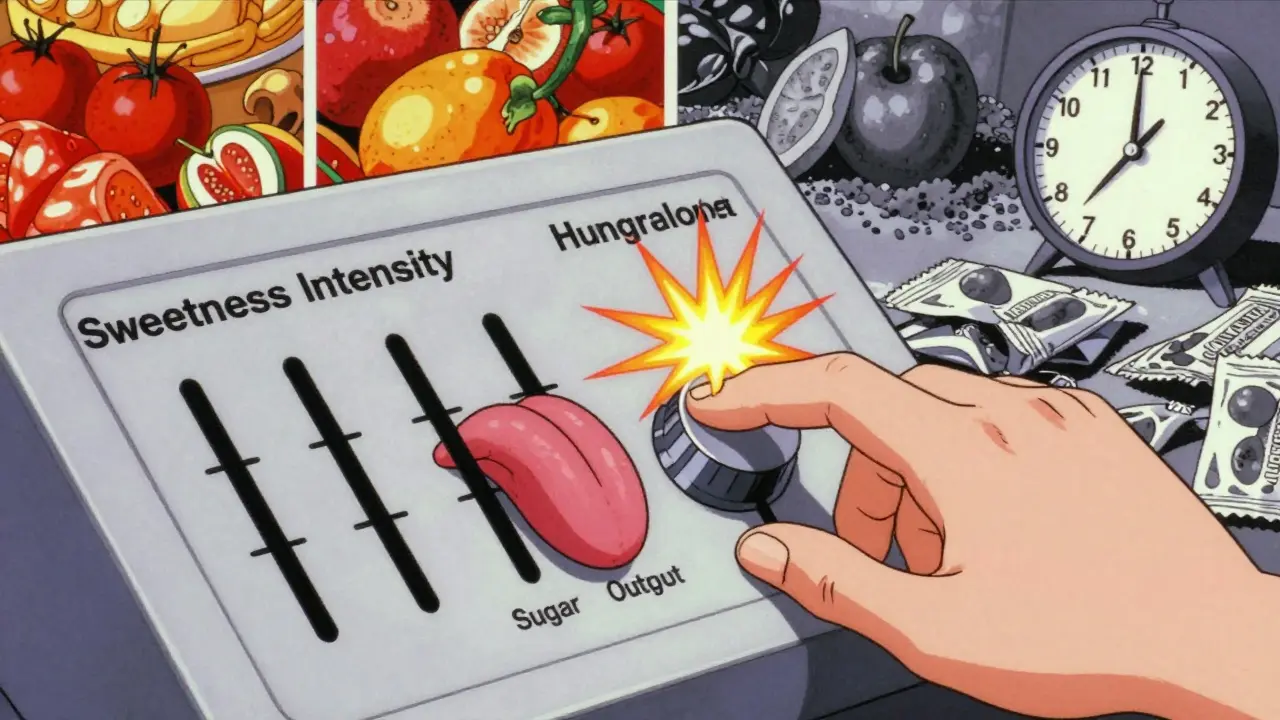
The Real Problem: Sweetness Addiction
The biggest issue with artificial sweeteners isn’t that they make you fat. It’s that they keep you hooked on sweetness. Think about it: when you drink diet soda every day, your taste buds adapt. Plain water tastes bland. An apple feels underwhelming. Your brain starts chasing that intense, pure sweetness-because that’s what it’s used to. Registered dietitians in Sydney and Melbourne report that most of their clients who struggle with cravings after switching to sweeteners need 4-6 weeks of reduced sweetness to reset their palate. No sugar. No sweeteners. Just whole foods: vegetables, lean meats, nuts, plain yogurt, berries. It’s hard. But it works.What Should You Do?
Here’s what the evidence says to try:- If you’re using diet soda daily, cut back. Try sparkling water with lemon or lime instead.
- If you sweeten coffee, switch from sucralose or aspartame to a small amount of stevia or monk fruit.
- Never use sweeteners as an excuse to eat more junk food. A sugar-free cookie is still a cookie.
- Pair any sweetener with protein or fiber. Greek yogurt with a drop of stevia beats a sugar-free muffin.
- Give your taste buds a break. Go 2-3 weeks with no added sweetness at all. You’ll be surprised how much food starts tasting better.
Alex Danner
January 8, 2026 AT 09:28Man, this post hit me right in the feels. I switched to diet soda for a year thinking I was being healthy-ended up eating entire bags of chips just because my brain kept screaming for more sweetness. It’s like my taste buds got hijacked. Now I drink sparkling water with a squeeze of lime and honestly? Food tastes better. Not just less sweet-more real. Like, I can taste the earth in my carrots now. Wild.
Also, the part about women having stronger brain reactions? That’s 100% me. My sister and I both cut sugar, but she’s still craving cake at 2 a.m. while I’m fine. Biology isn’t fair, but at least now I know why.
Ayodeji Williams
January 9, 2026 AT 14:54bro the real conspiracy is that the FDA and Big Diet Soda are in bed together 😈
they don’t want you to know that sweeteners are just chemical mind control to keep you addicted and buying more crap 🤫🥤
they even put it in baby food now. i saw it on a forum. trust me.
Kyle King
January 10, 2026 AT 19:48Oh wow so now it’s not just Big Sugar but also Big Artificial Sweetener? Next they’ll say the moon landing was faked and your fridge is spying on you.
Look, if you’re eating sugar-free cookies and still gaining weight, maybe the problem isn’t the sweetener-it’s that you’re eating sugar-free cookies. That’s like blaming your treadmill for not making you lose weight while you eat a whole pizza after your ‘workout.’
Kamlesh Chauhan
January 12, 2026 AT 08:46so sweeteners make you crave more but sugar makes you fat so what do you even do
just eat normal food i guess
but then you get bored
so you go back to diet soda
and then you crave more
its a loop
we are all doomed
send help
or just a donut
Rachel Steward
January 14, 2026 AT 01:01Let’s be clear: this isn’t about biology or hormones. It’s about behavioral economics and Pavlovian conditioning. You’re not ‘craving’-you’re performing a learned response. The brain doesn’t ‘get confused.’ It’s a predictive coding system that updates its models based on reward prediction error. Sweeteners create a mismatch between sensory input and metabolic outcome, which triggers compensatory consumption-not because of ‘hunger signals,’ but because your brain’s reward circuitry has been reweighted.
And yes, sex differences exist because estrogen modulates dopamine receptor density in the nucleus accumbens. But that doesn’t mean women are ‘more sensitive.’ It means their neurochemistry is more responsive to environmental cues. Stop pathologizing gender. Start analyzing systems.
Jonathan Larson
January 14, 2026 AT 23:24Thank you for this thoughtful and meticulously referenced piece. It is rare to encounter such a balanced synthesis of clinical data, neurobiological insight, and practical guidance in the public discourse on nutrition.
What strikes me most is the emphasis on the relationship with food rather than the food itself. We have, as a culture, outsourced our intuitive eating instincts to labels, calories, and chemical substitutes. The true liberation lies not in choosing between sugar and sucralose, but in reclaiming the sensory joy of unprocessed nourishment-without guilt, without quantification, without the illusion of control.
May we all learn to listen to the quiet voice beneath the noise.
Elen Pihlap
January 16, 2026 AT 14:33i hate this so much i just ate 3 cookies and i dont even like cookies
Sai Ganesh
January 17, 2026 AT 02:14Interesting data. In India, we traditionally use jaggery or date syrup in small amounts. No artificial sweeteners. People here don’t have the same cravings because sweetness is tied to meals, not snacks. Also, we eat more fiber, more spices-curry leaves, cardamom, black pepper. They help regulate appetite. Maybe the problem isn’t just sweetness-it’s how we eat it.
Also, water with lemon is better than diet soda. Always.
Aparna karwande
January 18, 2026 AT 09:52How dare you suggest that artificial sweeteners are a legitimate alternative? This is Western junk science imposed on the world! In India, we’ve been using natural sweeteners like jaggery and honey for millennia-no lab-made chemicals, no brain rewiring, no corporate lies. You think your ‘diet’ soda is saving you? It’s poisoning your children’s neural development. The West is addicted to convenience, not health. We don’t need your sucralose. We need our roots.
And if you think stevia is better? You’re still chasing sweetness. The answer is not less poison-it’s no poison at all.
Jessie Ann Lambrecht
January 18, 2026 AT 20:15Okay but real talk-this post saved my life. I was drinking 3 diet sodas a day and snacking constantly. I thought I was being good. Turns out I was just tricking my brain into thinking it was starving. I went 10 days with zero added sweetness-just water, tea, eggs, veggies, nuts. Day 4 was rough. Day 7? I tasted the sweetness in an apple and cried. Like, actually cried.
Now I use a drop of monk fruit in my coffee and I’m not obsessed. I’m not craving. I’m just… eating. And I feel like a human again. You’re not broken. Your brain just needs a reset. You got this.