
If you take levothyroxine for hypothyroidism and eat soy products like tofu, soy milk, or edamame, you might be unknowingly reducing how well your medication works. It’s not that soy is bad for your thyroid-it doesn’t cause hypothyroidism. But it can block your body from absorbing the hormone replacement you need. The good news? You don’t have to quit soy. You just need to time it right.
Why Soy Interferes with Thyroid Medication
Soy contains compounds called isoflavones-mainly genistein and daidzein-that stick to levothyroxine in your gut. Think of it like Velcro: the soy proteins grab onto the medication before your body can absorb it. This cuts down how much of the drug actually gets into your bloodstream. Studies show this can reduce absorption by 9% to 30%, depending on how much soy you eat and when you eat it.This isn’t a new discovery. Back in the 1960s, doctors noticed babies on soy formula needed higher doses of levothyroxine to stay healthy. Since then, dozens of studies have confirmed the same pattern in adults. One 2006 case report showed a woman who drank soy protein shakes with her pill needed to increase her dose from 100 mcg to 200 mcg. Her TSH levels shot up until she stopped combining them.
The real issue isn’t soy itself. It’s timing. When you take levothyroxine and eat soy at the same time, your body absorbs far less of the medication. That means your TSH-the hormone your doctor checks to see if your dose is right-can creep up. And if your TSH stays high, you’re still hypothyroid even if you think you’re taking your pill correctly.
How Much Soy Is Too Much?
Not all soy is created equal. Whole soy foods like tofu, tempeh, edamame, and soy milk have the strongest effect because they contain more protein and isoflavones. Soy protein powders and supplements can be even worse-they’re concentrated. A 2004 study found that soy reduced levothyroxine absorption by 30%, while fiber supplements like psyllium only cut it by 9%.But here’s the catch: if you eat soy once in a while, say a handful of edamame at dinner, it likely won’t hurt if you took your pill in the morning. The problem happens when soy becomes part of your daily routine-like drinking soy milk with breakfast every day. That’s when your body keeps getting hit with interference, and your thyroid levels start to drift.
Studies also show the effect is stronger in people who’ve been on levothyroxine for a long time or those with borderline thyroid function. One 2019 meta-analysis of 3,600 people found that soy only raised TSH levels in those who already had TSH above 4.5 mIU/L. So if your levels are stable, you might be fine. But if your TSH keeps creeping up, soy could be the silent culprit.
How Other Foods Compare
Soy isn’t the only thing that messes with levothyroxine. Calcium supplements can reduce absorption by 25-36%. Iron does the same. Coffee? About a 20% drop. Fiber? Around 10%. But soy sits in the middle-worse than coffee or fiber, but not as bad as calcium or iron.That’s why experts rank interference risks like this:
- Calcium supplements
- Iron supplements
- Soy products
- High-fiber foods
- Coffee
Calcium and iron need a full 4-hour gap. Coffee? Wait 60 minutes. Soy? Most guidelines say 2 to 4 hours. The exact number depends on your situation and what kind of soy you eat.
What the Experts Say
There’s some disagreement among doctors, and that’s confusing for patients. The American Thyroid Association says 2-3 hours between levothyroxine and soy is enough. But Dr. David Heber from UCLA says 4 hours. Mayo Clinic updated their advice in March 2023 to say 2 hours for most adults, but still recommend 3-4 hours for kids and babies.Why the difference? Because research keeps evolving. A January 2023 study in the European Thyroid Journal found that just 2 hours of separation was enough to bring absorption back to normal in adults. TSH changes were negligible-under 0.1 mIU/L. That’s why many clinics are now relaxing older advice.
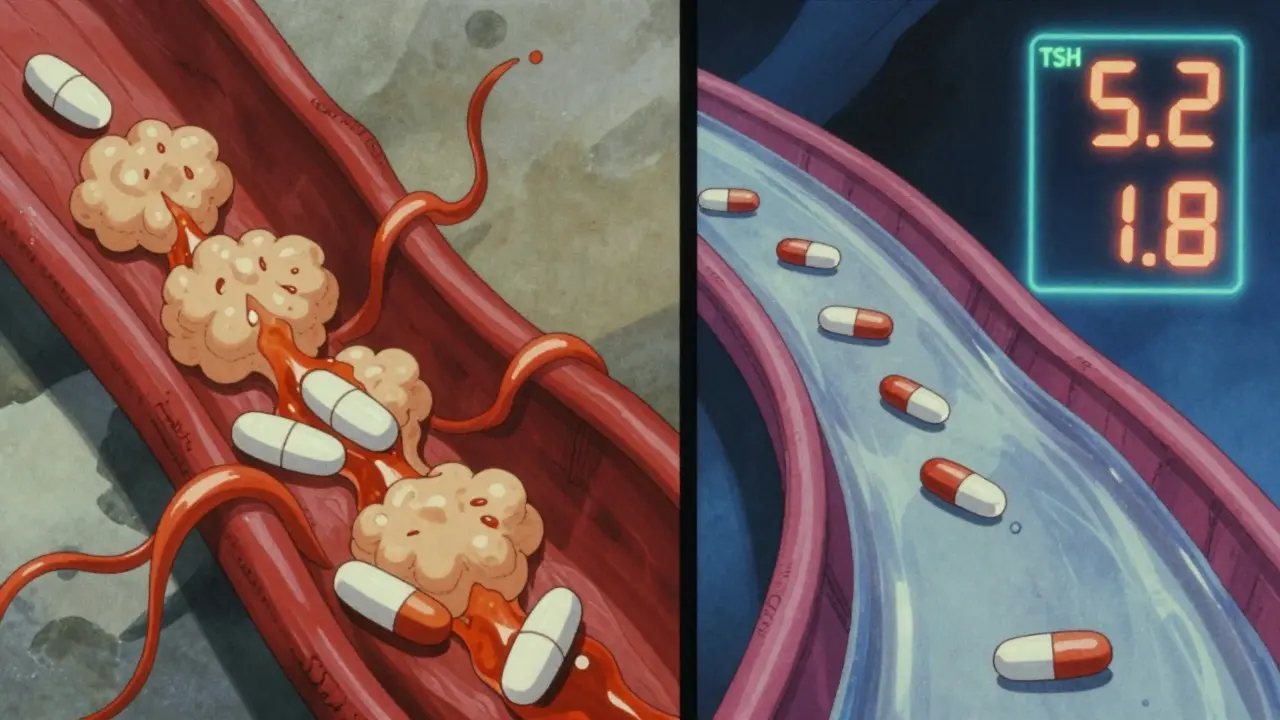
But real-world experience tells a different story. On Reddit’s thyroid community, one user went from a stable TSH of 1.8 to 5.2 after drinking soy milk with breakfast every day. Her dose had to go up by 25 mcg. Another user said she’s taken Synthroid with soy milk for five years and never had a problem. Her doctor says timing matters more than avoidance.
The truth? It varies by person. Genetics, gut health, and how your body processes hormones all play a role. That’s why one-size-fits-all advice doesn’t always work.
Best Practices for Taking Levothyroxine With Soy
Here’s what actually works, based on current guidelines and real patient outcomes:- Take levothyroxine on an empty stomach with a full glass of water. No food, no coffee, no supplements.
- Wait at least 60 minutes before eating anything else. This gives your body time to start absorbing the pill.
- Avoid soy for 2-4 hours after taking your pill. For most adults, 2 hours is enough. For children, infants, or if your TSH is unstable, go with 3-4 hours.
- Don’t take soy at the same time as calcium or iron. Those need 4 hours apart from levothyroxine. So if you’re having soy and calcium together, space them out from your pill too.
- Consider taking levothyroxine at bedtime. If you eat soy at dinner, taking your pill at night (2 hours after your last meal) can avoid the conflict entirely. Many patients find this easier than waiting hours in the morning.
- Keep it consistent. If you switch from morning to bedtime dosing, stick with it. Changing routines can throw off your absorption.
For vegans or vegetarians who eat soy daily, this isn’t about cutting out tofu. It’s about rearranging your schedule. Swap soy milk for almond milk in the morning. Eat edamame at lunch instead of breakfast. Have a soy protein shake after your afternoon snack, not right after your pill.
What If You Already Eat Soy With Your Pill?
If you’ve been eating soy with your levothyroxine and haven’t noticed any issues, you might be fine. But if your TSH has been creeping up, or your doctor keeps adjusting your dose, soy could be why.Here’s what to do:
- Track your soy intake. Write down what you eat and when you take your pill for a week.
- Separate them. Try waiting 3 hours after your pill before eating soy. Keep doing it for 6-8 weeks.
- Get your TSH retested. Ask your doctor to check your levels after the change.
- If your TSH drops back to normal, soy was likely the issue. If not, look at other culprits-calcium, iron, fiber, or coffee.
Some patients need a 50 mcg dose increase just because they drink soy milk every morning. Others never need to change a thing. Only testing tells you which group you’re in.
Special Cases: Babies, Vegans, and Older Adults
Infants on soy formula need special attention. Studies show they may need 15-30% more levothyroxine than babies on milk-based formula. Pediatric endocrinologists often recommend switching to non-soy formula if possible, or spacing the medication and formula by at least 4 hours.Vegans and vegetarians are at higher risk because soy is a staple. A 2022 survey found 74% of plant-based diet followers with hypothyroidism had been counseled on soy interactions-up from 42% in 2015. That’s good. But many still don’t know how to apply it.
Older adults with slower digestion may absorb medication differently. If you’re over 65 and your TSH keeps rising despite stable habits, talk to your doctor about soy timing. Your gut moves slower, so the interaction window might be longer.
What About Soy Supplements?
Soy isoflavone pills are even more concentrated than food. They’re often marketed for menopause or bone health. But if you’re on levothyroxine, these can be dangerous. One study found that even 100 mg of soy isoflavones per day caused a measurable drop in levothyroxine absorption. If you take these supplements, talk to your doctor. You may need to stop them entirely or space them out by 4 hours.Bottom Line: Timing Matters More Than Avoidance
You don’t have to give up tofu. You don’t need to stop drinking soy milk. You just need to stop eating it right after your pill. The science is clear: separation works. Most people can manage this with simple changes to their routine.Take your levothyroxine first thing in the morning. Wait 60 minutes. Eat your oatmeal. Wait 2-3 hours. Then have your tofu stir-fry. Or take it at night, 2 hours after dinner. Either way, you’re protecting your thyroid function without giving up your diet.
And if you’re unsure? Ask your doctor for a TSH test after you’ve changed your routine. That’s the only way to know if you’re getting the full benefit of your medication.
Can soy cause hypothyroidism?
No, soy does not cause hypothyroidism. It doesn’t damage the thyroid gland or reduce hormone production. But in people already taking levothyroxine, soy can reduce how much of the medication gets absorbed, which can make symptoms of hypothyroidism return. The issue is absorption, not thyroid function.
How long should I wait after taking levothyroxine before eating soy?
For most adults, wait at least 2 hours. For children, infants, or if your TSH has been unstable, wait 3-4 hours. The key is consistency. If you eat soy every morning, take your pill at night instead. Many people find this easier to stick with long-term.
Does all soy affect levothyroxine the same way?
No. Whole soy foods like tofu, soy milk, and edamame have the strongest effect because they contain more protein and isoflavones. Soy protein powders and supplements are even more concentrated and can cause bigger drops in absorption. Fermented soy like tempeh may have less impact, but it’s still best to space it out.
Can I take levothyroxine at night instead of in the morning?
Yes, and for many people, it’s better. Taking levothyroxine at bedtime, at least 2 hours after your last meal, avoids conflicts with soy, coffee, calcium, and other foods. Studies show nighttime dosing works just as well as morning dosing, and many patients find it easier to remember and stick to.
What if I forget and eat soy right after my pill?
One mistake won’t ruin your treatment. But if it happens often, your TSH levels may rise over time. If you do it once, don’t panic. Just avoid soy for the rest of the day and take your next dose as scheduled. If it happens regularly, change your routine. Track your symptoms and ask your doctor for a TSH test.
Anil bhardwaj
February 26, 2026 AT 16:45Been taking levothyroxine for 8 years and eating tofu every morning. Never had an issue. My TSH is always perfect. Maybe it’s just my gut? Or maybe the science is overblown. Either way, I’m not changing my routine.
John Smith
February 27, 2026 AT 05:59Oh wow another ‘soy is the devil’ post. Next you’ll tell me oxygen interferes with levothyroxine. People, stop overcomplicating your lives. If your TSH is stable, stop obsessing. If it’s not, see a doctor-not a Reddit post.
Shalini Gautam
February 27, 2026 AT 09:28As an Indian woman who eats soy every day-dal, tofu, soy milk-I’m shocked this is even a debate. My mom took levothyroxine for 15 years and never missed a meal. If you’re worried, get tested. Don’t listen to fear-mongers.
Natanya Green
March 1, 2026 AT 01:47OMG I just realized I’ve been eating edamame with my Synthroid for THREE YEARS 😭 I thought I was being healthy!! My TSH must be through the roof!! I’m going to cry and also immediately switch to almond milk and take my pill at midnight. This changed my life.
Steven Pam
March 1, 2026 AT 21:29This is actually super helpful! I’ve been struggling with my TSH for months and never thought soy could be the culprit. I just switched to taking my pill at night-2 hours after dinner-and my last test came back perfect. If you’re stuck, try this. It’s not about giving up soy, it’s about timing. Small change, huge difference.
Timothy Haroutunian
March 3, 2026 AT 09:23Let’s be real. The whole soy-levothyroxine thing is a perfect example of medical overreach. You’ve got people panicking over a 9% absorption dip while ignoring the fact that 40% of patients don’t even take their meds consistently. The real problem isn’t tofu-it’s that people don’t take pills on time, forget to retest, or think a blog post replaces a doctor. Also, who eats soy for breakfast anymore? That’s a 2005 problem.
Erin Pinheiro
March 5, 2026 AT 08:03So if I eat soy at lunch and take my pill at 6am, am I fine? Or do I have to wait 4 hours? I’m so confused. My doctor said 2 hours. My pharmacist said 4. My cousin’s yoga teacher said avoid it entirely. I’m just trying to live my life.
Michael FItzpatrick
March 6, 2026 AT 15:47Here’s the real takeaway: your body is not a lab test. It’s a living, breathing system that adapts. Some people absorb levothyroxine like a sponge. Others? Not so much. The key isn’t rigid rules-it’s awareness. Track your food, track your labs, track your energy. If your mood’s stable and your TSH’s in range? You’re doing fine. If not? Adjust. No shame, no fear, just data.
Brandice Valentino
March 7, 2026 AT 23:13I’ve been vegan for 10 years and have never had a thyroid issue. Also, I think this whole thing is a Big Pharma ploy to sell more meds. Soy is ancient. Levothyroxine is synthetic. Who are you trusting here? The ayurvedic texts or a 2023 study funded by a pharma company?
Larry Zerpa
March 9, 2026 AT 18:37Let’s not pretend this is nuanced. The data is clear: soy reduces absorption. Studies show 9-30%. That’s not ‘maybe’. That’s a measurable, documented interaction. People who say ‘I’m fine’ are either lucky, have excellent metabolism, or haven’t tested in 2 years. This isn’t about fear-it’s about pharmacokinetics. If you’re taking a life-sustaining drug, don’t gamble with bioavailability.
Gwen Vincent
March 11, 2026 AT 12:06I used to drink soy milk every morning with my pill. Then I started taking it at night. My energy improved. My hair stopped falling out. My TSH dropped from 5.1 to 1.9. It wasn’t magic-it was timing. You don’t have to quit soy. Just move it. It’s that simple.
Holley T
March 13, 2026 AT 08:51Everyone’s talking about timing but no one’s talking about the fact that levothyroxine absorption varies wildly based on gut health, stomach acid, and even probiotics. Soy might be a factor, but if your gut is inflamed from gluten or SIBO, that’s probably doing more damage than a bowl of tofu. Stop blaming soy. Start fixing your microbiome. Also, I’ve been taking my pill with coffee for 12 years. Still fine. Maybe the guidelines are outdated?