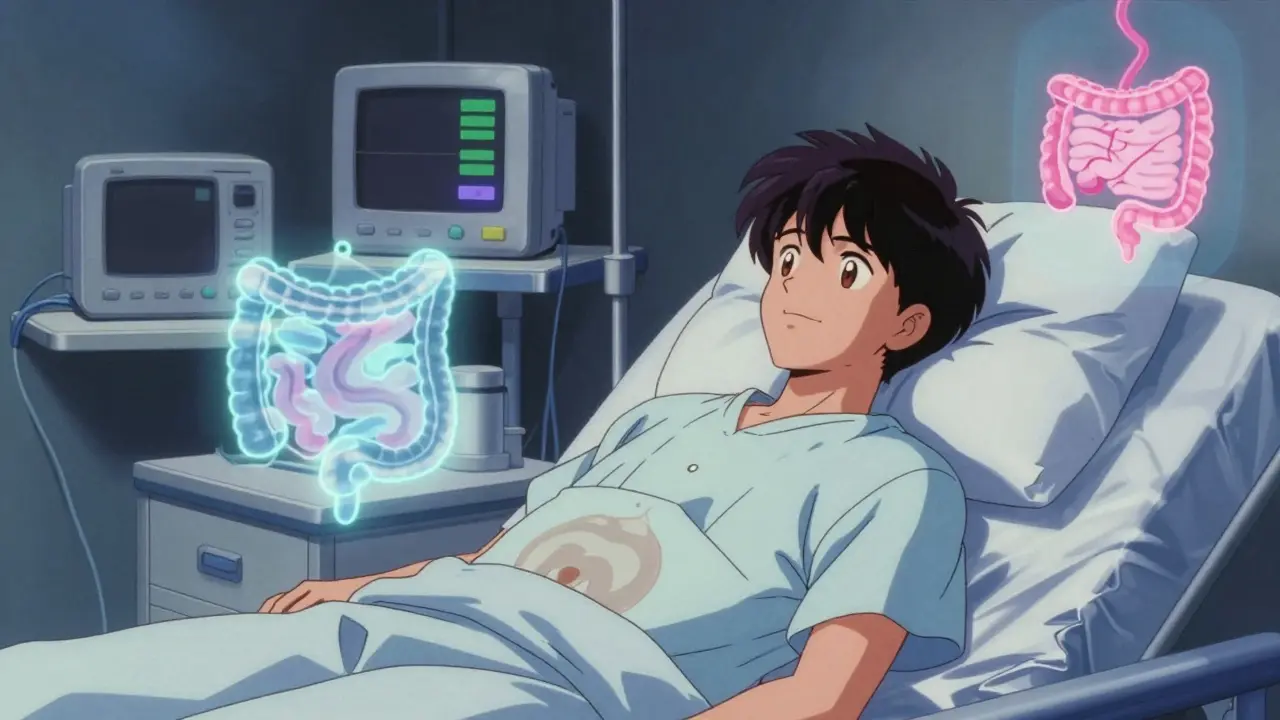
When medications for Crohn’s disease or ulcerative colitis stop working, surgery isn’t a failure-it’s often the best path back to a normal life. About 75% of people with Crohn’s and 15-30% of those with ulcerative colitis will eventually need surgery. For many, it means the end of constant pain, urgent bathroom trips, and the fear of bleeding or bowel emergencies.
What Happens During IBD Surgery?
IBD surgery isn’t one single procedure. It’s a set of options chosen based on the type of disease, where it’s located, and how much of the bowel is damaged. The two main goals: remove the diseased part and restore or reroute digestion safely.For Crohn’s disease, surgeons often do a resection. That means cutting out the inflamed section of the small intestine or colon and reconnecting the healthy ends. If the disease is only in the right side of the colon, a right colectomy with ileocolic anastomosis is common. About 60-70% of patients stay in remission for five years after this, but without ongoing treatment, the disease usually comes back-often near the reconnection site.
For ulcerative colitis, the most common surgery is a proctocolectomy-removing the entire colon and rectum. Since the disease only affects the colon and rectum, taking them out cures it. But removing the rectum means you can’t store stool anymore. That’s where two options come in: an ileal pouch-anal anastomosis (IPAA), or a permanent ileostomy.
The J-Pouch: IPAA Surgery Explained
The ileal pouch-anal anastomosis, or J-pouch, is the most popular choice for people with ulcerative colitis who want to avoid a permanent bag. Surgeons take the last 8-10 centimeters of the small intestine, shape it into a J or S, and attach it directly to the anus. It acts like a new rectum, storing stool so you can still go to the bathroom normally.This surgery usually happens in two or three stages. First, the colon and rectum are removed, and a temporary ileostomy is created. This lets the new pouch heal without stool passing through it. After 8-12 weeks, the second surgery connects the pouch to the anus. Finally, the temporary stoma is closed. About 75% of these procedures follow this three-step path.
Success rates are high: 80-90% of patients report being satisfied with their quality of life after IPAA. Most have 4-8 bowel movements a day, no blood, and no need for medications. But it’s not perfect. Up to 40% develop pouchitis-an inflammation of the pouch-requiring antibiotics. Some need additional surgeries. And while most regain control, about 32% of patients still deal with nighttime leakage, needing pads.
Permanent Ostomy: When a Bag Is the Best Choice
Not everyone is a candidate for a J-pouch. If the anal sphincter is damaged, if you’re over 70, or if you have Crohn’s disease affecting the pouch area, a permanent ileostomy is safer. In this procedure, the end of the small intestine is brought through the abdominal wall to create a stoma-about the size of a quarter. Waste flows out into a bag attached to the skin.It sounds scary, but many people say it’s life-changing. One Reddit user wrote: “I went from 15 bathroom trips a day to zero stress. I can travel, sleep through the night, and eat without fear.” About 65% of people who get a permanent ostomy say they feel better than before surgery.
The stoma sticks out 1-2 cm from the belly. You empty the bag 4-6 times a day. Specialized bags are designed to be discreet, odor-free, and secure. Skin irritation is common at first, but with the right barrier creams and proper fitting, most people adapt quickly. A certified wound, ostomy, and continence nurse (WOCN) teaches you how to change the appliance, manage skin health, and avoid leaks.
Long-term satisfaction is high: 85% of permanent ostomy patients report being happy with their choice after five years. Unlike the J-pouch, there’s no risk of pouchitis, no need for antibiotics, and no second surgery to reverse anything.

Recovery and Postoperative Care
Recovery starts the moment you wake up from surgery. Hospital stays vary: a laparoscopic resection might take 3-5 days; an IPAA with temporary stoma can mean 5-7 days for the first stage. Most people walk the day after surgery. Pain is managed carefully, but IBD patients have a 22% higher risk of becoming dependent on opioids after surgery than other abdominal surgery patients. Doctors now use multi-modal pain plans-mixing acetaminophen, nerve blockers, and minimal opioids-to reduce this risk.For J-pouch patients, the first few months are a learning curve. Bowel movements can be frequent-up to 10 a day-before settling into 4-8. You’ll need 8-10 cups of fluids daily to avoid dehydration. High-fiber foods like raw veggies, nuts, and popcorn are avoided at first because they can block the new pouch. Your diet slowly expands over 6-12 months.
Watch for warning signs: fever over 38.3°C (101°F), sudden increase in output over 1,500 mL per day, or severe abdominal pain. These could mean infection, leak, or blockage. About 68% of IPAA patients are readmitted within 90 days, mostly for dehydration or pouchitis. Permanent ostomy patients have lower readmission rates-around 42%-because complications are easier to spot and manage.
Who Gets Which Surgery?
Choosing between a J-pouch and a permanent ostomy isn’t just about medical factors-it’s personal. Surgeons at NYU Langone and Cleveland Clinic say they tailor recommendations based on age, anatomy, and lifestyle.Younger patients under 40 are over three times more likely to choose a J-pouch. They want to avoid a bag, believe they can handle the recovery, and plan to have children. But here’s the catch: women who get a J-pouch have a 50-70% risk of infertility due to scar tissue near the fallopian tubes. Men face a 15-20% chance of new erectile dysfunction.
Patients over 65 usually choose permanent ostomy. Why? Higher risk of complications from multiple surgeries. Slower healing. More chance of pouch failure. For them, one surgery, one bag, and no more hospital visits for revisions is the safer bet.
Crohn’s disease patients rarely get J-pouches. Even if the disease is only in the colon, there’s still a risk it will come back in the pouch. One study showed 50% of Crohn’s patients who got a J-pouch ended up needing a permanent stoma within five years. That’s why surgeons avoid it unless absolutely necessary.

What’s New in IBD Surgery?
Technology is changing how these surgeries are done. Laparoscopic (keyhole) surgery is now the standard-used in 65% of cases. It means smaller scars, less pain, and shorter hospital stays. Robotic surgery is growing fast. Mayo Clinic reports 20% shorter operation times and 15% fewer complications with robots compared to traditional laparoscopy.New tech is also helping with daily life. In 2023, the FDA approved the first “smart ostomy bag”-OstoLert by ConvaTec. It has sensors that alert you if there’s a leak or if the bag is nearly full. It costs about $80, but many insurance plans cover it.
Researchers are also testing microbiome transplants to prevent pouchitis. Early results show a 40% drop in inflammation after one year. Another trial at Cleveland Clinic is using 3D printing to design custom pouch shapes for each patient, aiming to improve function and reduce leaks.
Support and Resources
You’re not alone. Over 25,000 people are members of the United Ostomy Associations of America. Online communities like r/IBD on Reddit have 28,500 members sharing real tips-what belts work best, which bags don’t leak, how to sleep with a stoma. Many say finding a WOCN before surgery is the most important step. These nurses don’t just teach you how to change a bag-they help you rebuild your confidence.Costs vary. Medicare reimburses about $28,500 for a full IPAA and $18,200 for a stoma reversal. Ostomy supplies cost $100-$200 a month, but most insurance covers them. The Convatec Adapt Mini Ostomy Belt, which keeps the bag secure during exercise, runs $46.
Even with all the advances, the bottom line is simple: surgery for IBD isn’t about fixing a broken body. It’s about giving you back your life. For many, it’s the first time in years they can sleep through the night, eat a meal without dread, or plan a trip without mapping every bathroom.
Is IBD surgery a cure for ulcerative colitis?
Yes. Removing the entire colon and rectum cures ulcerative colitis because the disease only affects those organs. After a proctocolectomy, you won’t get another flare-up. However, if you have a J-pouch, you can still get pouchitis, which is inflammation of the new reservoir-but it’s not the same as ulcerative colitis.
Can I have kids after IBD surgery?
Women who have a J-pouch face a higher risk of infertility-up to 70%-due to scar tissue around the fallopian tubes. Men may experience erectile dysfunction in 15-20% of cases. A permanent ostomy doesn’t affect fertility. If you’re planning a family, talk to your surgeon before surgery. Some patients choose to freeze eggs or sperm beforehand.
How long does it take to recover from a J-pouch?
Full recovery takes 6-12 months. The first few weeks are spent healing from surgery. After the stoma is reversed, bowel movements are frequent-up to 10 times a day-and loose. Over time, the pouch stretches and learns to store stool. Most people settle into 4-8 bowel movements daily. Diet, hydration, and patience are key.
Do I need to change my diet after surgery?
Yes. For the first 3-6 months, avoid high-fiber foods like raw vegetables, nuts, seeds, popcorn, and whole grains-they can block the pouch or stoma. Eat small, frequent meals. Drink 8-10 cups of water daily to prevent dehydration. Many people find that cooked vegetables, eggs, lean meats, and white rice are easier to digest. Keep a food diary to track what triggers symptoms.
Can I exercise or swim with an ostomy?
Absolutely. Most ostomy bags are waterproof and secure enough for swimming, running, yoga, and weightlifting. Many people use belts or specialized clothing to hold the bag in place during activity. You don’t need to avoid anything-just make sure the seal is strong. Some people use a second barrier or skin prep before swimming. Talk to your WOCN about products designed for active lifestyles.
What’s the risk of needing more surgery after an IBD procedure?
About 25% of people who have a three-stage J-pouch will need another surgery within five years-usually for pouch failure, strictures, or fistulas. For permanent ostomy patients, that number drops to 10-15%. Crohn’s patients who have a resection have an 80% chance of needing another surgery within 10 years if they don’t stay on maintenance meds. Regular follow-ups and medication adherence are critical to prevent repeat surgeries.
Steve Hesketh
January 22, 2026 AT 03:54Man, I wish I’d known all this before I went under the knife. I had UC and got the J-pouch at 28-thought I was invincible. Turns out, my body had other plans. Pouchitis hit me hard, and I ended up in the ER three times in six months. But here’s the thing-I’m alive, I’m sleeping through the night, and I finally ate a taco without panic. Surgery didn’t fix me-it gave me back my life. You’re not broken. You’re rebuilding.
MARILYN ONEILL
January 23, 2026 AT 10:02Ugh. I can’t believe people still think a bag is ‘life-changing.’ It’s just… gross. I mean, who wants to carry around a stink bag? I’d rather die than have to empty one in public. And don’t even get me started on those ‘smart bags’-next they’ll be putting GPS trackers in your poop.
shubham rathee
January 23, 2026 AT 12:16Did you know the FDA approved that smart ostomy bag because Big Pharma wants you dependent on tech so they can charge more? They’re also hiding that 80% of pouch failures are caused by glyphosate in your food. I’ve been using vinegar rinses and it’s working better than any surgeon ever did. Also, the government pays surgeons extra to push J-pouches because they get reimbursed more. Check the CMS codes.
Sangeeta Isaac
January 23, 2026 AT 22:32Okay but the real MVP here is the WOCN. My nurse literally taught me how to put on a bag while crying over a burrito and then made me laugh by calling it my ‘butt purse.’ I thought I’d never wear shorts again. Now I wear bikini bottoms with a stoma and dance like no one’s watching. Also, the ConvaTec belt? Worth every penny. I ran a 5k with it. I’m not even kidding.
Alex Carletti Gouvea
January 24, 2026 AT 06:48This is why America needs to stop coddling people. If you can’t handle your own gut, maybe you shouldn’t be allowed to eat fast food. Why are we spending $28k on fancy pouches when we could just tell people to eat better? This is just another entitlement program dressed up as medicine.
Coral Bosley
January 26, 2026 AT 01:32I had the J-pouch. I lost my husband to complications. I had to watch him scream through every infection. I held his hand as he begged for death. And now I sit here reading about ‘high satisfaction rates’ like it’s some kind of self-help blog. There’s no ‘silver lining’ when your body betrays you. This isn’t empowerment. It’s a funeral with a PowerPoint.
Dee Monroe
January 26, 2026 AT 11:42There’s something beautiful about the human body’s capacity to adapt-even when it’s been torn apart. A J-pouch isn’t just a surgical trick, it’s a quiet rebellion against fate. A stoma isn’t a failure-it’s a new kind of intimacy with your own biology. We’ve been taught to fear loss, but maybe healing isn’t about going back to who you were. Maybe it’s about becoming someone who can carry weight-literal and emotional-and still walk forward. The bag doesn’t define you. The courage to wear it does.
Ben McKibbin
January 28, 2026 AT 04:36Just a heads-up for anyone reading this: if you’re considering surgery, get a second opinion from a center that does at least 50 IBD cases a year. I went to a community hospital first-they told me a resection was ‘enough.’ Six months later, I was back in the ER with a fistula. Went to Mayo Clinic, got the full procto, and now I’m hiking the Appalachian Trail. Don’t let a surgeon’s convenience be your life’s limitation. You deserve better than a Band-Aid on a grenade.