Hyponatremia Risk Calculator for Older Adults on SSRIs
This tool estimates your risk of developing hyponatremia (low blood sodium) while taking SSRIs based on factors discussed in the article. This is for informational purposes only and should not replace professional medical advice.
Your Risk Assessment
When you start an SSRI for depression, you expect relief from sadness, not confusion, dizziness, or nausea that feels like it came out of nowhere. But for some people-especially those over 65-these symptoms aren’t just bad luck. They could be warning signs of a dangerous drop in blood sodium, triggered by the very medication meant to help.
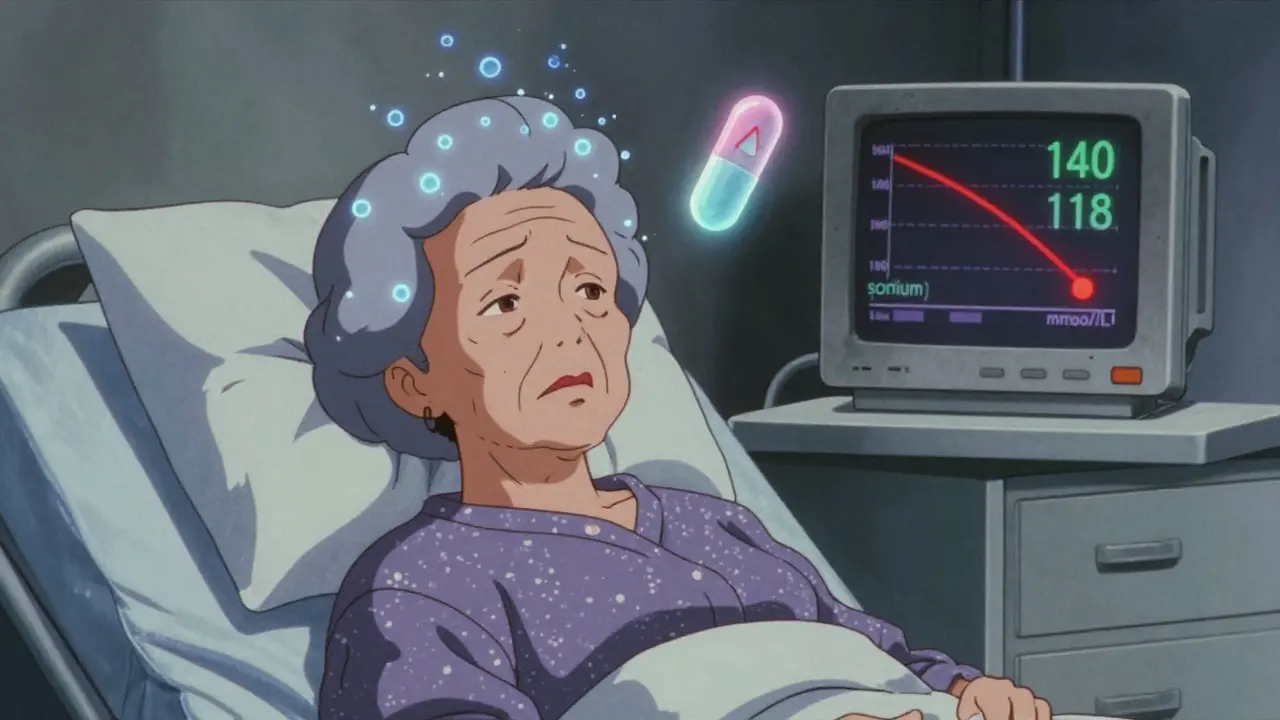
Hyponatremia, defined as a serum sodium level below 135 mmol/L, is one of the most common and underrecognized side effects of SSRIs. In severe cases, sodium can plunge to 118 or even 105 mmol/L. At that point, the brain starts swelling. Confusion turns to disorientation. Seizures can happen. Coma or death isn’t just a risk-it’s happened.
Why SSRIs Cause Low Sodium
It all starts with serotonin. SSRIs boost serotonin levels in the brain to improve mood, but serotonin doesn’t stay put. It also flows into areas of the hypothalamus that control antidiuretic hormone (ADH). When ADH gets overstimulated, your kidneys hold onto too much water. That water dilutes your sodium. The result? Hyponatremia.
This isn’t random. Studies show a clear link between how strongly an SSRI binds to the serotonin transporter (SERT) and how much sodium drops. Citalopram and sertraline, for example, have high SERT affinity-and they’re linked to the highest risk. Fluoxetine and paroxetine aren’t far behind. Even if you’ve taken SSRIs for years without issue, a small dose increase can push you over the edge.
Who’s Most at Risk?
Not everyone is equally vulnerable. The data is blunt: if you’re over 65, your risk jumps dramatically. A 2024 meta-analysis found that 13.9% to 18.6% of older adults on SSRIs develop hyponatremia. For someone under 50? Less than 2%. That’s not a small difference-it’s a cliff.
Other red flags include:
- Being female (65% of cases are women)
- Having a low body weight (under 60 kg)
- Having kidney problems (eGFR under 60)
- Taking a diuretic, especially a thiazide like hydrochlorothiazide (risk increases 4.2 times)
- Starting or increasing the SSRI dose too fast
And here’s the scary part: symptoms often show up between 2 and 4 weeks after starting the drug. That’s when people think they’re "adjusting" to the medication. They assume their headaches or fatigue are normal. But in older adults, these signs are often mistaken for dementia, stroke, or just "getting older." A 2023 patient survey found only 28.7% were ever warned about this risk before starting an SSRI.
Real Cases, Real Consequences
A 78-year-old woman in a 2022 case report started sertraline at 50 mg daily. Ten days later, she was admitted to the ICU with sodium at 118 mmol/L and signs of serotonin syndrome. She spent five days in intensive care.
On Reddit, a caregiver wrote about their 82-year-old mother: "Two weeks after starting citalopram, she couldn’t remember her own name. The hospital said her sodium was 122. They stopped the pill. It took three days for her to come back to herself. No one told us this could happen."
These aren’t rare outliers. The 2024 meta-analysis estimates that in the U.S., SSRI-induced hyponatremia costs $1.27 billion a year-mostly from ER visits and hospital stays. And that’s just what we see. Experts believe nearly 38% of mild cases go undiagnosed in primary care.

How It’s Diagnosed
Doctors don’t guess. They test. The diagnosis requires three things:
- Serum sodium below 135 mmol/L
- Urine sodium above 30 mmol/L (your kidneys are holding onto salt)
- Urine osmolality above 100 mOsm/kg (your body is concentrating urine too much)
And crucially, the patient must be euvolemic-neither dehydrated nor swollen. That rules out other causes like dehydration or heart failure. If sodium drops fast, the brain doesn’t have time to adapt. That’s when confusion, seizures, and coma happen.
What to Do If You’re on an SSRI
For patients over 65-or anyone with risk factors-there’s now a clear standard of care:
- Test before you start. A baseline sodium level should be checked within 7 days before starting any SSRI.
- Test again at 2 weeks. That’s when levels usually dip. If sodium drops below 135, stop the SSRI.
- Monitor monthly for 3 months. High-risk patients need ongoing checks.
Even if you feel fine, don’t skip these tests. Many people don’t have symptoms until sodium is dangerously low.
What Are the Alternatives?
SSRIs aren’t the only option. And for older adults, some are far safer.
Here’s how antidepressants stack up in hyponatremia risk, based on the 2024 meta-analysis:
| Antidepressant | Risk Relative to SSRIs | Notes |
|---|---|---|
| Citalopram | 2.37x higher | Highest risk among SSRIs |
| Sertraline | 2.15x higher | Commonly prescribed |
| Fluoxetine | 1.98x higher | Long half-life, delayed risk |
| Paroxetine | 1.82x higher | Strong anticholinergic effects |
| Venlafaxine (SNRI) | 1.72x higher | Modest risk |
| Duloxetine (SNRI) | 1.58x higher | Used for pain too |
| Amitriptyline (TCA) | 1.94x higher | Older, but still used |
| Bupropion | 0.85x (lower) | Non-serotonergic, good alternative |
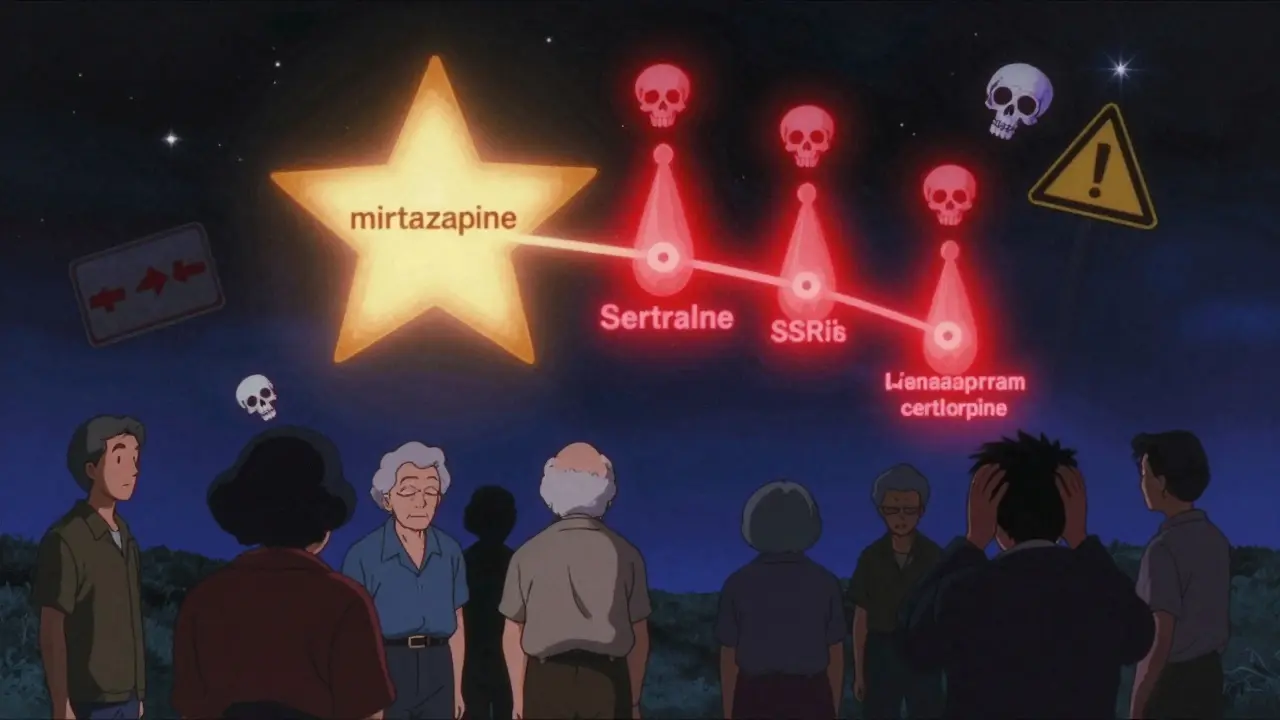
| Mirtazapine | 0.47x (lowest) | Safest for older adults |
Mirtazapine stands out. It doesn’t boost serotonin the same way SSRIs do. It works on different receptors, and it doesn’t trigger ADH release. The data is clear: for every 1,000 older adults prescribed mirtazapine instead of an SSRI, 12 fewer will develop hyponatremia. That’s why the American Geriatrics Society’s 2023 Beers Criteria now lists SSRIs as potentially inappropriate for older patients-and recommends mirtazapine or bupropion as safer first choices.
What Happens If Hyponatremia Is Caught?
Once diagnosed, treatment depends on severity:
- Mild (125-134 mmol/L): Stop the SSRI. Restrict fluids to 800-1000 mL per day. Sodium usually normalizes in 2-4 days.
- Severe (<125 mmol/L): Hospitalization needed. Give 3% hypertonic saline slowly-no more than 6-8 mmol/L increase in 24 hours. Too fast, and you risk brain damage from osmotic demyelination.
Recovery takes time. Even after sodium normalizes, confusion and weakness can linger for days. And if the SSRI is restarted later? The risk of recurrence is high.
What’s Changing in 2026?
The landscape is shifting. Between 2018 and 2023, SSRI use in people over 65 dropped 22.3%. Mirtazapine prescriptions for the same group jumped 34.7%. The FDA now requires all SSRI labels to warn about hyponatremia. The European Medicines Agency is reviewing safety data-results expected by late 2025.
And in March 2024, the first clinical algorithm for managing this condition was published. It’s simple: assess risk, test sodium early, switch if needed. No more waiting for someone to collapse before you act.
Bottom Line
SSRIs save lives. But they aren’t risk-free. For older adults, the risk of hyponatremia is real, common, and preventable. If you’re over 65, or caring for someone who is, ask: "Has my sodium been checked?" If you’re starting an SSRI, ask: "Is there a safer option?"
There’s no shame in choosing mirtazapine. It works. It’s effective. And for many, it’s the smarter, safer choice.
Brooke Exley
February 24, 2026 AT 08:21William James
February 25, 2026 AT 15:15Joanna Reyes
February 26, 2026 AT 21:26Nerina Devi
February 27, 2026 AT 18:03Dinesh Dawn
February 28, 2026 AT 02:13Vanessa Drummond
March 1, 2026 AT 23:06Nick Hamby
March 2, 2026 AT 00:26kirti juneja
March 3, 2026 AT 17:44Haley Gumm
March 4, 2026 AT 01:48