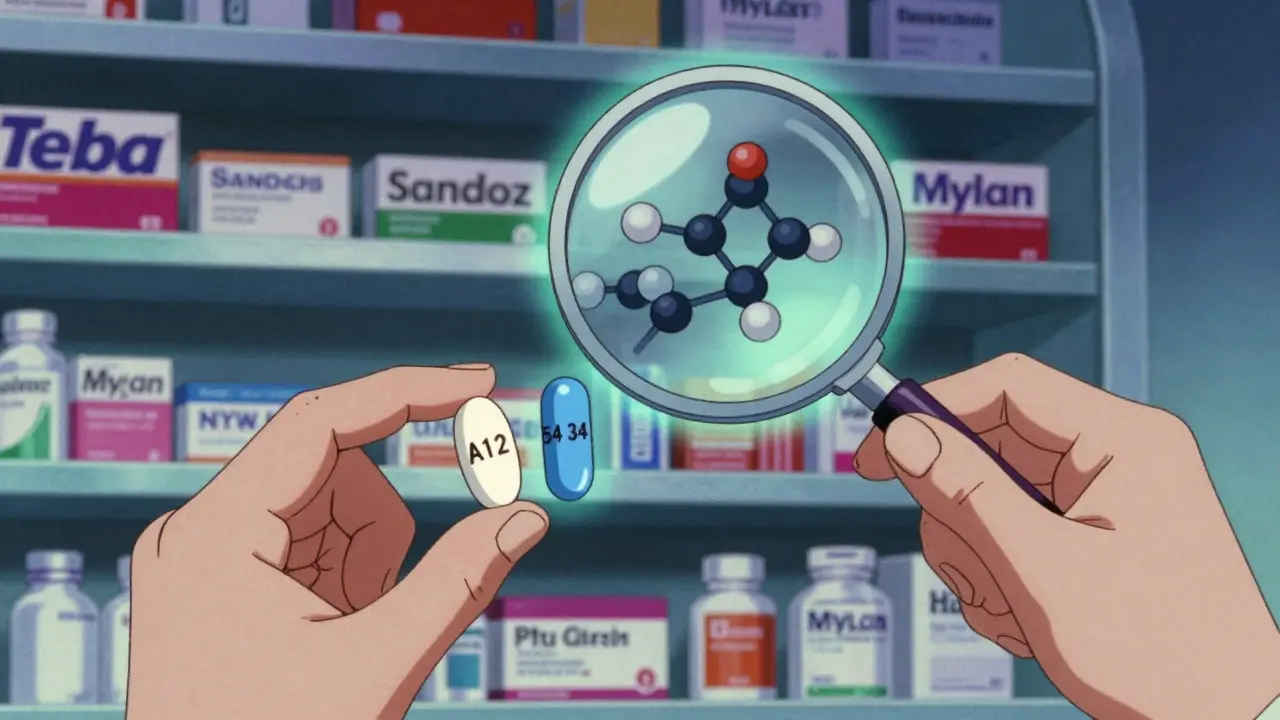
When you pick up a prescription, you might notice your pills look different-even if the name on the bottle hasn’t changed. That’s because generic drugs are made by different manufacturers, and each one designs their pills differently. You might get a white oval one month, then a blue capsule the next. It’s not a mistake. It’s normal. But it can be confusing, even scary, if you’re not sure what’s going on.
The truth is, generic drugs are just as safe and effective as brand-name versions. The U.S. Food and Drug Administration (FDA) requires them to have the same active ingredient, dose, and how they work in your body. But the outside? That’s where things change. Color, shape, size, and even the little letters or numbers stamped on the pill-those are all up to the manufacturer. And that’s by design.
Why Generic Pills Look Different
Generic drug makers can’t copy the exact look of brand-name pills. That’s because trademarks protect the appearance of brand-name drugs. If a generic looked identical, it could confuse patients or violate intellectual property laws. So instead, each manufacturer creates their own unique design. This means two generics for the same drug-say, amlodipine for high blood pressure-can look completely different.
According to a 2020 study in Nature Scientific Reports, 78% of generic drugs differ in color, 65% in shape, and 42% in size compared to the original brand. The imprint-the letters or numbers on the pill-is required by law (since the 1970s) so pharmacists and patients can identify it. But even that can change between manufacturers. One company might use "A12" while another uses "54 34". Neither is wrong. Both are approved.
How to Tell If a Generic Is Legit
Don’t rely on looks alone. A pill’s appearance doesn’t tell you if it works. What matters is whether it meets FDA bioequivalence standards. That means it must deliver the same amount of active ingredient into your bloodstream at the same rate as the brand-name drug. The FDA requires this difference to be within 80-125% of the brand’s performance. For most drugs, that’s a tiny gap-on average, only 3.5% difference in absorption, according to an FDA analysis of over 2,000 studies.
To verify a generic is legitimate, check the imprint. Use a reliable tool like the Drugs.com Pill Identifier (used by over 12 million people monthly). Enter the color, shape, and imprint. If it matches the FDA-approved listing, you’re good. Pharmacists also use the National Drug Code (NDC) directory, which links each pill to its manufacturer, strength, and formulation. If you’re unsure, ask your pharmacist. They can tell you if the new pill is the same drug, just made by a different company.
Who Makes Generic Drugs-and Does It Matter?
Not all generic manufacturers are the same. The big players include Teva, Mylan (now part of Viatris), Sandoz, and Hikma. Teva, the world’s largest, made $16.3 billion in 2023 and supplies about 9% of all U.S. generic prescriptions. These companies don’t just make pills-they invest in quality control, manufacturing standards, and supply chain reliability.
First-to-market generics often have the highest quality because they reverse-engineer the brand-name drug with precision. But once more companies enter the market, prices drop sharply. With three competitors, prices fall about 20%. With ten or more, they can drop 70-80%. That’s great for your wallet-but it can mean switching between manufacturers more often.
Some manufacturers specialize in complex drugs like extended-release tablets, inhalers, or injectables. These require more testing and take longer to approve. Hikma, for example, spends 3-5 years developing one complex generic, while a standard tablet might take 1-2 years. If you’re on one of these drugs, sticking with the same manufacturer might be safer.
When Appearance Changes Might Mean Something
For most people, switching generic manufacturers causes no issues. But for drugs with a narrow therapeutic index (NTID), even small changes can matter. These are medications where the difference between a helpful dose and a harmful one is very small. Examples include warfarin (blood thinner), levothyroxine (thyroid hormone), and some seizure or psychiatric drugs like lamotrigine or phenytoin.
A 2012 case study in the Journal of Generic Medicines found patients experienced unexplained toxicity after switching lamotrigine manufacturers. While rare, these cases show why consistency matters for NTID drugs. The FDA recommends using "dispense as written" (DAW-1) codes on prescriptions for these drugs. That means your doctor tells the pharmacist: "Don’t substitute. Give me the exact brand or generic I prescribed."
If you’re on one of these drugs and your pill changes color or shape, talk to your doctor. Ask if you should stay with the same manufacturer. Many patients report better stability when they stick with one maker-even if it costs a bit more.
What Patients Say About Generic Switches
Surveys tell a mixed story. A 2022 Consumer Reports survey of 1,532 patients found 41% worried about appearance changes. Eighteen percent said they’d question their pharmacist if the pill looked different. On Reddit’s r/pharmacy community, 68% of 1,247 respondents reported no problems switching generics. But 22% said they noticed changes in how they felt-especially with antidepressants or anti-seizure meds.
These reports aren’t proof that generics don’t work. They’re clues that some people are sensitive to minor differences in inactive ingredients-like fillers, dyes, or coatings. These don’t affect how the drug works, but they can change how fast it dissolves or how your stomach reacts. For most, it’s nothing. For a few, it’s enough to notice.
How to Stay in Control
You don’t have to guess when your pill changes. Here’s how to stay informed:
- Check the imprint. Write down the letters/numbers on your pill. Use Drugs.com or ask your pharmacist to look it up.
- Ask about the manufacturer. Your pharmacist can tell you which company made your pills. If you prefer one, ask them to order it.
- Use DAW codes. If you’re on a narrow therapeutic index drug, ask your doctor to write "DAW-1" on your prescription.
- Track changes. Keep a small note in your phone or wallet: "My levothyroxine is a white oval with "50" on one side, made by Teva. If it changes, call my pharmacy."
- Don’t panic. If your pill looks different but you feel fine, it’s probably fine. But if you feel off-dizzy, tired, nauseous-contact your provider.
What’s Changing in the Generic Market
The generic drug industry is evolving. In 2023, 90.5% of U.S. prescriptions were filled with generics. But supply chain issues have caused 67% of current drug shortages to involve generics. The FDA is working to cut approval times for complex generics by 30% by 2028. Meanwhile, "authorized generics"-brand-name companies selling their own unbranded versions-are growing. They made up 15% of generic prescriptions in 2023.
These changes mean more competition, lower prices, and more switching. But they also mean you need to be more aware. Your pill might change again next month. That doesn’t mean it’s less effective. But it does mean you should know how to check it.
Final Takeaway
Generic drugs save Americans an average of $265 per month compared to brand-name versions. That’s real money. And for most people, switching between manufacturers is completely safe. But appearance changes can trigger anxiety or confusion. The key is knowing what to look for and how to verify your medication. You don’t need to be a pharmacist. You just need to know your pill’s imprint, ask questions, and speak up if something feels off.
Remember: a different-looking pill doesn’t mean a weaker drug. But it does mean you should stay informed. Your health isn’t a gamble. It’s a choice-and you have the right to make it with confidence.
Why do generic pills look different even if they’re the same drug?
Generic pills look different because trademark laws prevent them from copying the exact color, shape, or imprint of brand-name drugs. Each manufacturer designs their own version, but all must contain the same active ingredient and meet FDA bioequivalence standards. The differences are only in inactive ingredients and appearance-not how the drug works in your body.
Can switching between generic manufacturers affect how well a drug works?
For most drugs, no. The FDA requires generics to be bioequivalent, meaning they deliver the same amount of active ingredient into your bloodstream within a very tight range (80-125% of the brand). Studies show average differences are only 3.5%. But for drugs with a narrow therapeutic index-like warfarin, levothyroxine, or lamotrigine-even small changes can matter. In these cases, staying with the same manufacturer may be safer.
How can I identify my generic pill if it looks different?
Look for the imprint-the letters or numbers stamped on the pill. Combine that with the color, shape, and size, and enter them into the Drugs.com Pill Identifier tool. Your pharmacist can also look up the National Drug Code (NDC) to confirm the manufacturer and strength. Never rely on appearance alone-always verify with the imprint or NDC.
Should I ask my doctor to prescribe a specific generic manufacturer?
Yes, especially if you’re on a narrow therapeutic index drug or have noticed side effects after switching. You can ask your doctor to write "DAW-1" on your prescription, which tells the pharmacy to dispense only the exact brand or generic you’re on. Some patients find it helpful to keep a note of their preferred manufacturer’s pill appearance.
Are generic drugs from foreign manufacturers safe?
Yes, if they’re approved by the FDA. Many U.S. generics are made overseas, but the FDA inspects all manufacturing facilities-whether in the U.S., India, China, or elsewhere. All must meet the same quality standards. The FDA’s Drug Supply Chain Security Act also tracks drug shipments to prevent counterfeit products. Always get your meds from a licensed pharmacy, not online vendors without verification.
Dylan Patrick
March 14, 2026 AT 18:24Been there. Got the blue capsule. Thought I was hallucinating. Turned out it was just Teva’s version of my amlodipine. No side effects, no drama. Just a different shade of blue.
Pharmacists aren’t trying to fool you. They’re just swapping out who made the pill. The FDA doesn’t sleep on this stuff.
Trust the imprint, not the color.
rakesh sabharwal
March 16, 2026 AT 13:52The fundamental epistemological flaw in contemporary pharmacoeconomic discourse lies in its conflation of bioequivalence with therapeutic equivalence. One must interrogate the ontological status of inactive excipients-particularly in drugs with narrow therapeutic indices-where microvariations in dissolution kinetics, attributable to polymorphic crystalline forms or surfactant matrices, may precipitate clinically significant deviations in pharmacokinetic profiles.
While the FDA’s 80–125% AUC threshold is statistically defensible, it is epistemologically insufficient for subpopulations exhibiting idiosyncratic metabolic phenotypes. The reductionist paradigm of pill identification via imprint codes is a performative illusion of control, masking deeper structural vulnerabilities in the global supply chain.
Serena Petrie
March 18, 2026 AT 05:05My pill changed color. I panicked. Turned out it was fine. Don’t make a big deal.
Elsa Rodriguez
March 20, 2026 AT 04:33I switched generics and felt like a zombie for two weeks. No one believes me. My doctor said ‘it’s all the same.’
But my anxiety spiked. My sleep vanished. I swear, the new pill made me feel like my brain was wrapped in saran wrap.
Now I only take the one with ‘A12’ on it. Even if it costs $15 more. I’d rather pay than feel like I’m slowly turning into a ghost.
Amisha Patel
March 20, 2026 AT 12:18Just checked my levothyroxine. It’s a white oval with ‘50’ on one side. Made by Teva.
I wrote it on my phone notes. If it changes, I’ll call my pharmacy.
Feels good to have a little system. No drama. Just clarity.
Kathy Leslie
March 21, 2026 AT 05:28I get why people freak out. Pills are tiny, but they carry so much weight.
For me, it’s not about the drug-it’s about the feeling of control.
When my pill changes, I feel like my body doesn’t belong to me anymore.
So I ask. I write it down. I talk to my pharmacist like they’re my ally.
And honestly? That’s the real medicine.
Buddy Nataatmadja
March 21, 2026 AT 23:54My cousin in Delhi takes the same generic for hypertension as I do in Texas.
Same active ingredient. Different imprint. Different color.
But both work. The world’s weird like that.
Pharma’s global, but the pill you hold? It’s yours.
Just know what to look for.
mir yasir
March 23, 2026 AT 21:12It is axiomatic that the commodification of pharmaceuticals necessitates the obfuscation of therapeutic continuity through aesthetic variance. The FDA’s regulatory framework, while ostensibly robust, operates under a paradigm of statistical aggregation that disregards individual pharmacodynamic heterogeneity.
One must question the ethical imperative of permitting interchangeability for NTID agents without mandatory manufacturer traceability on packaging.
The patient is not a variable in a regression model. They are a sentient being whose physiological equilibrium is not a matter of probability, but of lived experience.