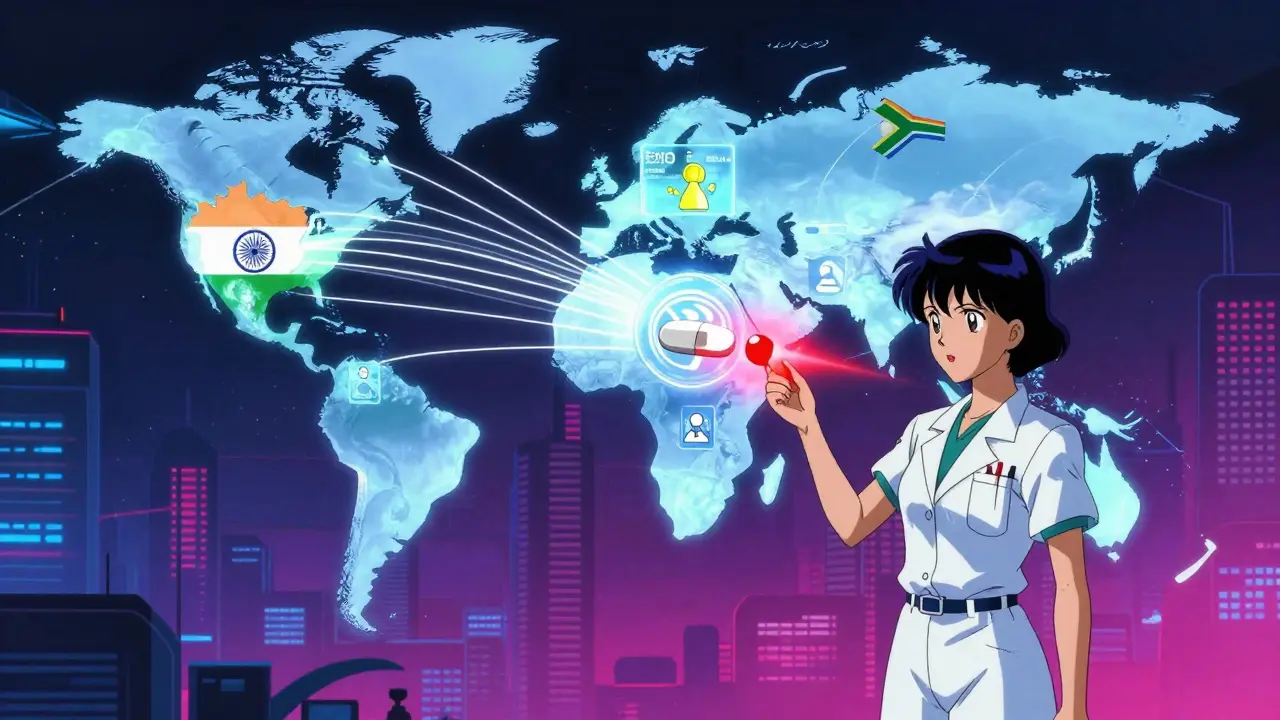
Every year, millions of people take generic drugs made in one country and used in another. But when something goes wrong - a rare side effect, a dangerous interaction - how do regulators know? And how do they act fast enough to protect patients across borders? The answer lies in pharmacovigilance harmonization, the quiet but critical effort to make drug safety monitoring work the same way everywhere.
Why Global Drug Safety Needs to Be Standardized
Imagine a patient in Brazil develops a severe skin reaction after taking a generic blood pressure pill made in India and sold in South Africa. The same drug is also in use in Germany and the U.S. Without shared standards, each country might miss the pattern. One might report it as a fluke. Another might not collect the data at all. By the time someone connects the dots, dozens more could be harmed. That’s why the International Council for Harmonisation (ICH) was created in 1990. It brought together regulators from the U.S., Europe, and Japan to build common rules. Today, over 80 countries follow ICH guidelines. The goal? No more redundant reports. No more delays. Just faster, smarter safety alerts. The result? The FDA estimates harmonization cuts time to market by 15-20%. It also avoids repeating clinical trials on 2.5 million patients every year - trials that could expose people to unnecessary risk.The ICH E2 Series: The Backbone of Global Reporting
The real engine of harmonization is the ICH E2 series of guidelines. These aren’t suggestions - they’re mandatory standards for how safety data is collected, coded, and shared.- E2B(R3) is the electronic format for Individual Case Safety Reports (ICSRs). It tells companies exactly how to structure every piece of data: patient age, drug dose, reaction type, timeline. Before this, reports came in as PDFs, spreadsheets, even faxes. Now, 89% of the top 50 pharma companies use E2B(R3), cutting transmission errors by 63%.
- E2E sets the template for Risk Management Plans (RMPs). These are documents that explain how a drug’s risks will be tracked after it’s on the market.
- PSURs (Periodic Safety Update Reports) must now follow the same format globally, so regulators can compare data across regions without reformatting.
Where the Rules Still Don’t Match Up
Even with ICH guidelines, regional differences linger - and they’re costly. In the European Union, companies must report all serious adverse events within 15 days. In the U.S., the FDA only requires expedited reporting for events that are both serious AND considered possibly linked to the drug by the sponsor. That means a company might report the same reaction in Europe but not in the U.S. - doubling the work. Japan’s PMDA uses its J-STAR system to analyze 12 million patient records. The EU uses electronic health records across 100 million patients through DARWIN EU. The U.S. Sentinel Initiative tracks 300 million. But in Brazil or South Africa, less than 15% of potential data sources can even be processed. Many countries still rely on paper forms. And then there’s the problem of definitions. One country calls a reaction “expected” if it’s listed in the label. Another says “expected” only if it’s been seen in clinical trials. This 47% inconsistency in labeling reactions makes it hard to spot real signals. A 2023 survey of 152 pharmacovigilance managers found that 82% spend time adapting reports for different regions. One professional on Reddit said they spend 35-40% of their week just reformatting documents.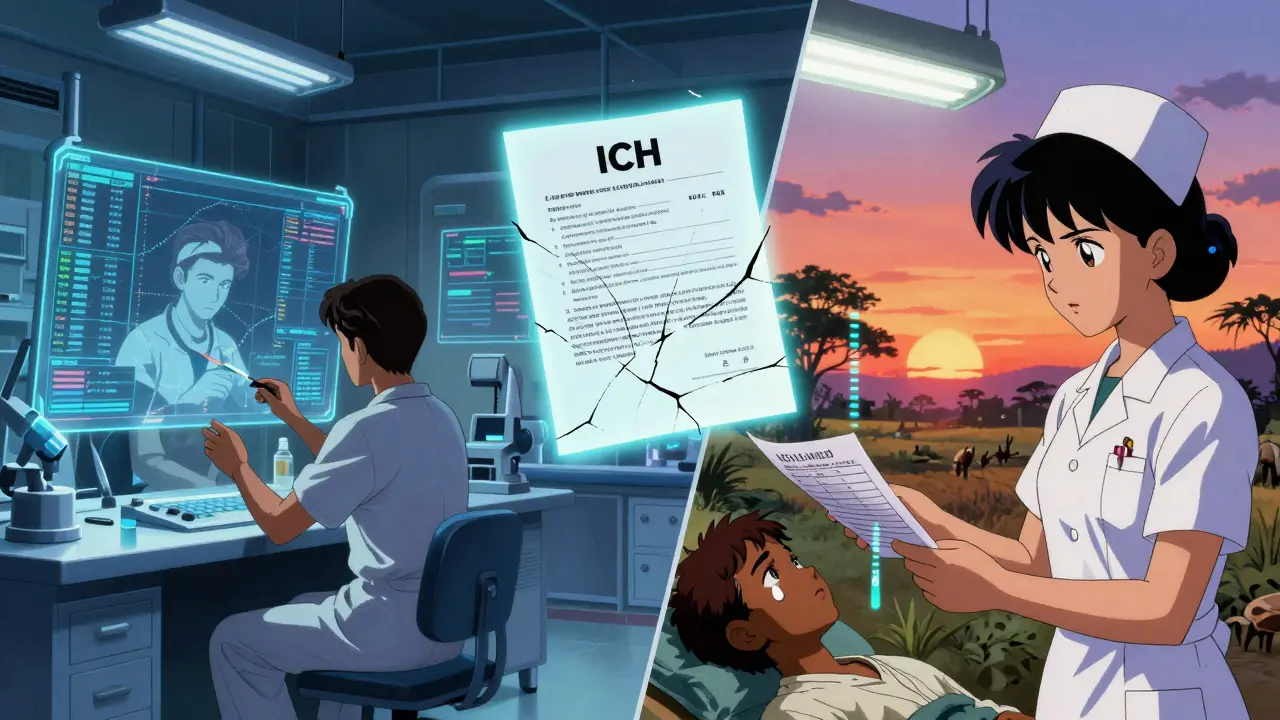
AI Is Changing the Game - But Unevenly
The biggest leap forward isn’t in paperwork. It’s in technology. Since 2022, the FDA and EMA have used machine learning to scan safety reports. These tools cut signal detection time by 30-40%. Japan’s PMDA launched AI models in 2023 that reduced false alarms by 25% - meaning fewer wasted investigations. But here’s the catch: these tools need data. And data needs infrastructure. High-income countries are integrating EHRs, pharmacy records, and claims data into their systems. In low- and middle-income countries, only 31% have fully adopted ICH E2B(R3). Many don’t have digital systems at all. The Access to Medicine Foundation found that 74% of pharmacovigilance staff in these regions lack the tools to meet even basic standards. The result? A two-tiered system. Companies with global operations spend millions to run parallel systems - one for rich markets, one for emerging ones.Who’s Leading and Who’s Falling Behind
The European Medicines Agency (EMA) leads in transparency and scope. All new drugs must have a full Risk Management Plan. They monitor millions of patients through national health systems. The U.S. FDA is more targeted. They use Risk Evaluation and Mitigation Strategies (REMS) only for high-risk drugs - about 1.2% of approved products. This keeps the system lean but risks missing signals on lower-risk drugs. Canada’s Health Canada aligns closely with ICH but keeps its own 30-day reporting rule for serious events. China’s NMPA moved fast since 2020 but still requires local reporting within 15 days - forcing global companies to file twice. And then there’s VigiBase - the WHO’s global database. With over 35 million individual case reports from 134 countries, it’s the largest pharmacovigilance archive in the world. It’s not used for regulatory decisions directly, but it’s the safety net. When a rare reaction shows up in three countries, VigiBase is often the first place it’s spotted.The Cost of Not Harmonizing
It’s not just about bureaucracy. It’s about lives. Deloitte estimates that full harmonization could prevent 1,200-1,500 drug-related deaths per year by catching dangers faster. It could also save $2.3 billion annually in duplicated work. But the price tag to get there is steep. Low- and middle-income countries need $1.8 billion just to build the basic infrastructure - digital reporting systems, trained staff, data links to hospitals. Right now, most of that funding doesn’t exist. Pharmaceutical companies aren’t immune either. TransCelerate Biopharma found that regional differences increase global pharmacovigilance costs by 22%. That’s money spent on people reformatting reports, not on finding real safety issues.
Nishant Garg
January 16, 2026 AT 01:17Man, I’ve seen this play out in Mumbai - a guy gets a rash from a generic statin made in Gujarat, shipped to Kenya, and sold in Nairobi. No one connects the dots till someone in Berlin flags it on VigiBase. We’re all on the same planet, yet we treat drug safety like it’s a national sport with different rules. ICH E2B(R3) should be mandatory everywhere - not just for Big Pharma’s convenience, but because a kid in Lagos deserves the same safety net as a retiree in Stockholm.
Nicholas Urmaza
January 16, 2026 AT 08:45Let’s be real - if we’re going to harmonize, why are we still letting Europe dictate the pace? The FDA knows what’s best for American patients. We don’t need some international committee telling us how to track side effects. We’ve got 300 million data points and AI that can predict reactions before they happen. Stop outsourcing safety to bureaucrats in Brussels.
Amy Ehinger
January 17, 2026 AT 15:43I work in pharmacy data entry and I can tell you - the paperwork alone is insane. One report, three formats, five different systems. I’ve spent whole weekends just re-coding reactions because the EU called it 'hepatotoxicity' and the FDA said 'liver enzyme elevation.' It’s not efficiency - it’s chaos. I’m glad someone’s finally talking about this. Hope the new AI standards actually help real people and not just consultants.
Crystel Ann
January 18, 2026 AT 11:12It’s heartbreaking to think that someone in a rural clinic might miss a life-threatening reaction just because they don’t have internet or a trained pharmacist. I used to volunteer in Guatemala and saw how patients relied on handwritten reports passed between towns. We have the tools now - why are we still leaving people behind? This isn’t just about compliance. It’s about dignity.
Niki Van den Bossche
January 19, 2026 AT 05:01Harmonization? How quaint. You’re all pretending this is about patient safety, but it’s really about corporate consolidation. The ICH guidelines were designed by Big Pharma to eliminate competition from local manufacturers. Why do you think Brazil’s PMDA is being pressured to adopt E2B(R3)? So multinational corporations can bury small labs under compliance debt. The real villain isn’t bureaucracy - it’s profit-driven globalization masquerading as progress.
Iona Jane
January 20, 2026 AT 12:59They’re watching us. Every report you file, every adverse event - it’s all feeding some global surveillance network. The WHO’s VigiBase? It’s not a safety tool - it’s a biometric database. They’re building a global pharmacovigilance AI that knows what drugs you take, where you live, and how your body reacts. Next thing you know, your insurance rates go up because you took a blood pressure pill in 2023. Wake up.
Diane Hendriks
January 20, 2026 AT 18:12It’s absurd that we still tolerate paper forms in 2024. This isn’t 1985. If a country can’t digitize adverse event reporting, they shouldn’t be allowed to import drugs. American taxpayers fund global health initiatives - we’re not subsidizing analog systems in countries that refuse to modernize. Either adopt ICH standards or get off the global supply chain.
ellen adamina
January 22, 2026 AT 04:54I’ve been in pharmacovigilance for 18 years and I’ve never seen anything this fragmented. I remember when we used to fax reports. Now we’re emailing JSONs and still losing data. The real issue isn’t the tech - it’s the lack of training. A nurse in Peru can’t interpret E2B(R3) if they’ve never used a computer. We need field workers, not just IT upgrades.
Sohan Jindal
January 23, 2026 AT 11:58Why should we care about what happens in Malawi? Our drugs are safe here. If someone overseas gets sick from a cheap pill, that’s their problem. We don’t need to fix the world’s broken healthcare systems. Just keep our own patients safe. Stop globalizing our liabilities.
Frank Geurts
January 25, 2026 AT 07:33While the technical frameworks of ICH E2B(R3) and PSUR standardization represent monumental strides toward global pharmacovigilance coherence, it is imperative that we acknowledge the profound epistemological and infrastructural asymmetries that persist across the Global North and South. The imposition of high-fidelity digital reporting protocols upon low-resource settings, without concurrent investment in human capital and localized data ecosystems, constitutes a form of techno-colonialism that undermines the very equity these standards purport to advance.
Mike Berrange
January 26, 2026 AT 10:03Everyone’s talking about AI and harmonization like it’s a miracle cure. But let’s be honest - most of these 'signal detection' tools are just fancy filters that miss the weird stuff. I’ve seen a case where a rare neurological reaction got flagged in Germany, ignored in Canada, and buried in a spreadsheet in India. AI doesn’t fix bad data - it just makes bad data look official.
Jami Reynolds
January 27, 2026 AT 09:15They say harmonization saves lives. But who’s really benefiting? The WHO’s VigiBase has 35 million reports - but only 3% of them come from low-income countries. That’s not global data. That’s Western data with a global label. This whole system is designed to protect the pharmaceutical industry’s bottom line, not the patient in the village without electricity.
RUTH DE OLIVEIRA ALVES
January 27, 2026 AT 14:45For years, we’ve treated pharmacovigilance like a checklist - fill out the form, submit the report, move on. But safety isn’t transactional. It’s relational. It’s about trust between a nurse in Jakarta and a regulator in Geneva. The real breakthrough won’t be in E2B(R3) or AI - it’ll be when we start listening to the people on the ground, not just digitizing their silence.
Nat Young
January 28, 2026 AT 03:071,500 deaths prevented? $2.3 billion saved? Where’s your source? This whole post reads like a pharma lobbying doc. I’ve worked in compliance - the real cost isn’t paperwork, it’s the 12-hour meetings where 5 people argue over whether 'dizziness' counts as 'serious.' Harmonization won’t fix that. It’ll just make the meetings international.