
Drinking a glass of grapefruit juice with your morning pills might seem like a healthy habit. But for people taking certain medications, it could be dangerous-sometimes life-threatening. This isn’t a myth or an old wives’ tale. It’s a well-documented, scientifically proven interaction that affects more than 85 prescription drugs. And the worst part? Many people don’t even know they’re at risk.
How Grapefruit Juice Changes How Your Body Handles Medication
Grapefruit juice doesn’t just taste tangy-it changes how your body absorbs and processes drugs. The culprit? Furanocoumarins, natural chemicals found in grapefruit, especially in the peel and pulp. These compounds shut down an enzyme in your small intestine called CYP3A4. This enzyme normally breaks down about half of all oral medications before they enter your bloodstream. When it’s blocked, your body absorbs way more of the drug than it should.That might sound good-more drug means better effect, right? Not at all. Too much drug in your system can lead to overdose-like symptoms, even if you took your normal dose. The effect isn’t temporary. One 200-milliliter glass of grapefruit juice (about 6.7 ounces) can block CYP3A4 for up to 72 hours. That means even if you take your pill hours after drinking grapefruit juice, or drink the juice hours after taking your pill, the interaction still happens.
What’s worse, this isn’t something you can predict. Two people taking the same drug might react completely differently. One might see a 2-fold increase in drug levels, another might see an 8-fold spike. It depends on your genetics, your gut enzymes, and even how ripe the grapefruit was. There’s no blood test to tell you if you’re at risk. So if your medication is on the list, the only safe choice is to avoid grapefruit entirely while you’re on it.
Medications That Can Become Dangerous With Grapefruit Juice
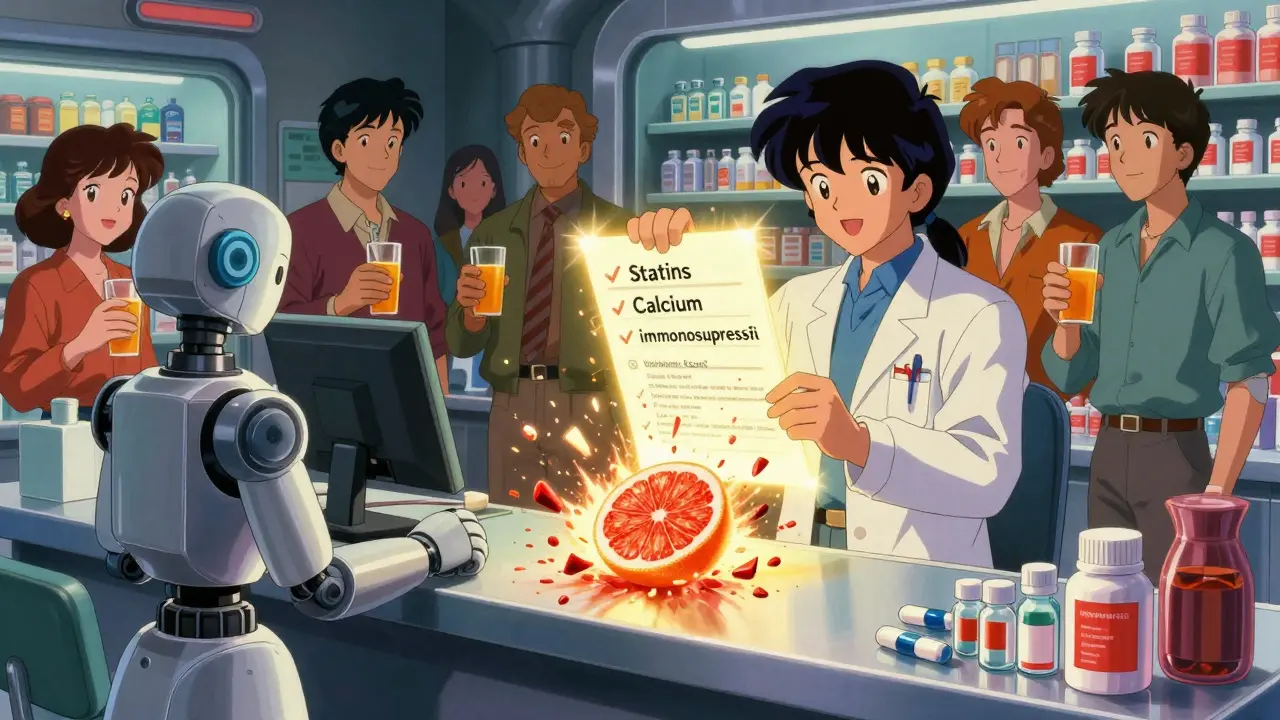
Not all drugs are affected equally. But some of the most commonly prescribed ones are among the most dangerous when mixed with grapefruit. Here are the big ones:- Statins (cholesterol-lowering drugs): Simvastatin (Zocor) is the worst offender. Just one glass of grapefruit juice a day for three days can triple your blood levels of simvastatin. That raises your risk of rhabdomyolysis-a rare but serious muscle breakdown that can lead to kidney failure. Atorvastatin (Lipitor) has a milder interaction, but still risky. Pravastatin and rosuvastatin? Safe. If you’re on simvastatin and drink grapefruit juice, talk to your doctor about switching.
- Calcium channel blockers (blood pressure meds): Felodipine (Plendil) and nifedipine (Procardia) can see their levels jump 5-fold and 3.3-fold respectively. That can cause your blood pressure to drop too low, leading to dizziness, fainting, or even heart problems. Amlodipine (Norvasc), on the other hand, is unaffected.
- Immunosuppressants: Cyclosporine (Neoral), used after organ transplants, can increase by 50-60% with grapefruit juice. That raises the risk of kidney damage and other toxic effects. Tacrolimus is a safer alternative for transplant patients who want to enjoy citrus.
- Antiarrhythmics: Amiodarone (Cordarone), used for irregular heartbeats, can have its levels rise by 30-40%, increasing the risk of dangerous heart rhythms.
- Some antidepressants and sedatives: Trazodone and zolpidem are generally safe. But others, like certain benzodiazepines, can become dangerously potent.
The FDA requires drug labels to warn about grapefruit interactions for 76% of affected medications. If your prescription bottle says “avoid grapefruit,” don’t ignore it. Even if you’ve been drinking grapefruit juice for years with no problem, your body’s enzyme levels can change over time. What was safe last year might not be safe today.
What About Other Citrus Fruits?
Not all citrus is the same. Seville oranges (used in marmalade) and pomelos contain the same furanocoumarins as grapefruit and should be avoided too. But sweet oranges-like navel or Valencia-and lemons? They’re safe. They don’t contain the compounds that block CYP3A4. So if you’re craving citrus, stick to those.Some people think “I’ll just have a little bit.” But there’s no safe threshold. Even a small glass can cause a significant interaction. And it’s not just juice-whole grapefruit, grapefruit extracts, and even some grapefruit-flavored candies or supplements can trigger the reaction. If you’re on a high-risk medication, skip it all.

Who’s Most at Risk?
Older adults are especially vulnerable. People over 65 make up 40% of grapefruit juice drinkers in the U.S., and they’re also the group most likely to be taking multiple medications-often three to five at a time. Many of those meds are the ones that interact with grapefruit. That’s a dangerous combo.Also, if you’ve had a heart transplant, kidney transplant, or are on long-term immunosuppressants, your margin for error is tiny. A small spike in drug levels can mean rejection or organ damage. If you’re on statins and have muscle pain or weakness, that could be an early sign of rhabdomyolysis. Don’t wait. Talk to your doctor.
And here’s something many don’t realize: grapefruit interactions aren’t just about prescription drugs. Some over-the-counter medications and herbal supplements can also be affected. Always check with your pharmacist before adding anything new to your routine.
What Should You Do?
If you’re on medication, here’s what to do:- Check your meds. Look at the label. If it says “avoid grapefruit,” do it. If you’re not sure, ask your pharmacist. They’re trained to catch these interactions.
- Keep a list. Write down every medication, supplement, and OTC drug you take. Bring it to every appointment. Pharmacists use this list to screen for interactions during dispensing-89% of them do it routinely.
- Ask about alternatives. If you’re on simvastatin and love grapefruit, ask if you can switch to pravastatin or rosuvastatin. If you’re on cyclosporine, ask about tacrolimus. There are often safer options.
- Don’t assume it’s safe. Even if you’ve been drinking grapefruit juice for years with no issues, your body changes. So does your medication regimen. What was fine last year might not be now.
- Be clear with your doctor. Tell them you drink grapefruit juice-or that you used to. They need that info to make safe prescribing decisions.
Is There Hope for the Future?
Researchers are working on solutions. In October 2023, the USDA announced that CRISPR-edited grapefruit with 90% less furanocoumarin had passed early safety trials. If this works, we might one day have a version of grapefruit that’s safe to eat with meds. But that’s years away. Right now, the only safe rule is: if your drug interacts, avoid it.It’s not about giving up a favorite drink. It’s about protecting your health. Millions of people take statins, blood pressure meds, and transplant drugs every day. For them, grapefruit juice isn’t a breakfast habit-it’s a hidden risk. And that risk is real, measurable, and preventable.
Can I have grapefruit juice if I take my medication at night and drink juice in the morning?
No. The enzyme-blocking effect of grapefruit juice lasts 24 to 72 hours. Even if you take your pill at night and drink juice the next morning, the enzyme is still inhibited. The interaction doesn’t depend on timing-it depends on whether the enzyme is active when the drug passes through your gut. Avoid grapefruit entirely while on affected medications.
Is grapefruit juice worse than eating the whole fruit?
It’s about the same. Both contain the same furanocoumarins. Juice might have slightly higher concentrations because it’s more concentrated, but eating the whole fruit still delivers enough to block CYP3A4. Neither is safe if you’re on a high-risk medication.
Do all statins interact with grapefruit juice?
No. Simvastatin has the strongest interaction-tripling blood levels. Atorvastatin has a moderate effect. But pravastatin, rosuvastatin, and fluvastatin don’t interact significantly. If you’re on simvastatin and drink grapefruit juice, ask your doctor about switching to one of the safer options.
Can I drink grapefruit juice if I’m not on medication right now?
Yes, if you’re not taking any medication that interacts with it. But if you’re planning to start a new drug-especially for cholesterol, blood pressure, or after a transplant-ask your doctor first. The interaction doesn’t show up until you start the medication, so it’s best to be proactive.
Why don’t more people know about this?
Because the warning isn’t always clear. A 2022 survey found only 38% of patients recalled being told about grapefruit interactions when prescribed affected drugs. Doctors are busy. Pharmacists are overwhelmed. And grapefruit juice is marketed as healthy. But the science is clear: for certain medications, it’s a silent risk. Don’t assume you’ve been warned. Always ask.
Final Thought: When in Doubt, Skip It
Grapefruit juice isn’t the enemy. It’s full of vitamin C and antioxidants. But when it comes to certain medications, it’s a chemical wildcard. The interaction isn’t guesswork-it’s biology. And biology doesn’t care if you’ve been drinking it for years. It doesn’t care if you think you’re fine. It just responds to the chemicals in your gut.If you’re on a medication that interacts with grapefruit, the safest choice is simple: don’t drink it. Swap it for orange juice, lemon water, or just plain water. Your body will thank you.
Kelly Beck
January 6, 2026 AT 06:44OMG I just realized I’ve been drinking grapefruit juice with my statin for 5 years 😱 I’m so glad I saw this post-time to swap to orange juice ASAP 🍊💛
Rachel Wermager
January 6, 2026 AT 09:12The CYP3A4 inhibition mechanism is non-linear and dose-dependent, with interindividual variability driven by polymorphisms in the CYP3A5 gene and gut microbiome composition. Grapefruit’s furanocoumarins irreversibly inhibit intestinal CYP3A4 via mechanism-based inactivation. This is not a pharmacokinetic curiosity-it’s a clinically significant drug-food interaction with documented morbidity. You’re not ‘just being paranoid’ if you avoid it.
Leonard Shit
January 6, 2026 AT 09:36so i’m guessing this is why my grandpa passed out in the grocery store after his blood pressure med and a glass of ‘healthy’ juice…
rip grandpa. also rip my will to drink anything citrusy ever again.
Ryan Barr
January 7, 2026 AT 21:10Statins + grapefruit = bad. End of story.
Melanie Clark
January 8, 2026 AT 13:41Did you know the FDA knew about this since 2005 but didn’t mandate warning labels on juice bottles because the citrus industry lobbied hard? They’re more worried about your vitamin C intake than your liver
Also I heard the CRISPR grapefruit is a government cover-up to get us all hooked on lab-grown fruit so they can track us through our meds
Just saying. I stopped drinking anything with pulp after my cousin’s kidney transplant went south
They said it was ‘unrelated’ but I know what I saw
Jeane Hendrix
January 10, 2026 AT 11:07Wait so if I take my simvastatin at night and drink grapefruit juice in the morning… is it still dangerous? I’ve been doing this for years and my muscles feel fine? Should I get a blood test? I’m scared now but also really like grapefruit 😭
Also my pharmacist didn’t mention this when I filled my script… should I go back and ask? I feel dumb for not knowing.
Mukesh Pareek
January 12, 2026 AT 08:45The pharmacokinetic implications of furanocoumarin-mediated CYP3A4 inhibition are profound. The area under the curve (AUC) of affected statins increases by 200–800%, significantly elevating the risk of myotoxicity. This is not a ‘maybe’-it’s a pharmacogenomic reality. Your gut is not a variable resistor. It’s an enzymatic gatekeeper. And grapefruit? It’s a sledgehammer.
Molly McLane
January 13, 2026 AT 10:16My mom’s on cyclosporine after her transplant. She drinks orange juice every morning now. I’m so proud of her for switching. It’s not about giving up flavor-it’s about protecting your future.
Also, if you’re on meds, always check with your pharmacist. They’re the real superheroes of healthcare. And yes, they do remember your name. They probably know your meds better than your doctor does.
Katie Schoen
January 14, 2026 AT 15:45Okay but why is grapefruit juice the only food that gets a warning label and no one bats an eye at grapefruit-flavored soda or candy? That’s wild.
Also, I just Googled ‘grapefruit extract supplements’ and holy crap they’re everywhere. Are those even regulated? I’m gonna start a petition.
Indra Triawan
January 14, 2026 AT 18:13Perhaps the grapefruit is not the enemy… but a mirror. It reflects our blind trust in modern medicine, our addiction to quick fixes, our belief that nature can be tamed with a pill. We drink the juice for health… yet ignore the warning written in the language of enzymes. Maybe the real question is not ‘can I drink it?’ but ‘who am I, really, when I choose to ignore what my body is screaming?’
Peace.